
 admin
March 19, 2026
admin
March 19, 2026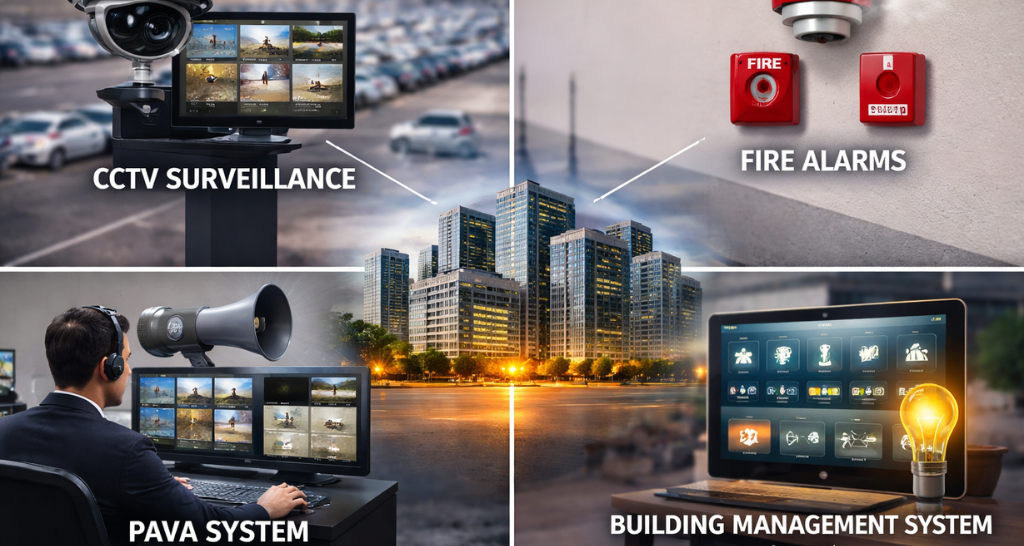
How ELV Systems Secure Large Facilities Like Auditoriums, Airports & Campuses?
Large-scale facilities such as auditoriums, airports, and educational campuses operate in highly dynamic environments. With thousands of people moving in and out daily, ensuring safety, security, and seamless operations becomes a complex challenge. This is where ELV (Extra Low Voltage) systems play a critical role.
ELV systems integrate multiple technologies security, communication, automation, and monitoring into a centralized infrastructure that enables smarter, safer, and more efficient facility management.
Let’s break down how ELV systems provide robust security and operational control across large facilities.
What Are ELV Systems?
ELV systems refer to low-voltage electrical systems used for communication, safety, and automation purposes. These typically include:
- CCTV Surveillance Systems
- Access Control Systems
- Public Address (PA) Systems
- Fire Alarm Systems
- Intrusion Detection Systems
- Building Management Systems (BMS)
- Networking & Structured Cabling
Individually, each system serves a specific purpose but when integrated, they create a powerful ecosystem that enhances overall security and operational efficiency.
Key Security Challenges in Large Facilities: Role of ELV Systems
Before understanding the solutions, it’s important to recognize the challenges:
- High Footfall: Thousands of visitors daily increase security risks
- Multiple Entry/Exit Points: Difficult to monitor manually
- Real-Time Threat Detection: Need for immediate response
- Large Physical Area: Coverage gaps can lead to vulnerabilities
- Operational Complexity: Managing multiple systems separately is inefficient
ELV systems are designed to address all these challenges through centralized, intelligent solutions, enabling Unified Collaboration & Communication across large facilities.
1. Advanced Surveillance with CCTV Systems
CCTV systems are the backbone of any ELV security infrastructure.
How It Helps:
- Provides 24/7 real-time monitoring
- Enables video recording and playback for investigations
- Uses AI-powered analytics for facial recognition, motion detection, and crowd monitoring
In Large Facilities:
- Airports: Monitor passenger movement and restricted zones
- Auditoriums: Track crowd density and entry points
- Campuses: Ensure student and staff safety
Modern IP-based cameras also allow remote access, making it easier for security teams to monitor from a central control room.
2. Access Control Systems for Restricted Security

Access control ensures that only authorized individuals can enter specific areas.
Key Features:
- Biometric authentication (fingerprint, face recognition)
- RFID card-based entry
- Mobile-based access systems
Use Cases:
- Airports: Restricted access to control rooms and baggage handling areas
- Auditoriums: VIP zones, backstage areas
- Campuses: Labs, admin offices, hostels
This eliminates unauthorized access and reduces dependency on manual security checks.
3. Public Address & Emergency Communication Systems
Communication is crucial during emergencies.
How ELV Systems Help:
- Real-time announcements across the facility
- Automated emergency alerts
- Integration with fire alarms and evacuation systems
Real-World Impact:
- In airports, passengers receive instant updates
- In auditoriums, evacuation instructions can be broadcast instantly
- In campuses, emergency alerts can reach thousands within seconds
Clear communication, supported by robust IT Infrastructure, minimizes panic and ensures orderly evacuation.
4. Fire Detection & Alarm Systems
Fire safety is non-negotiable in large infrastructures
ELV-Based Fire Systems Include:
- Smoke and heat detectors
- Fire alarm panels
- Automated sprinkler integration
- Emergency exit guidance
Benefits:
- Early detection reduces damage
- Automated alerts improve response time
- Integration with PA systems ensures faster evacuation
In large venues, even a few seconds can make a difference ELV systems ensure rapid response.
5. Intrusion Detection Systems
Intrusion detection systems add another layer of security, especially for off-hours monitoring.
Features:
- Motion sensors
- Door/window sensors
- Glass break detectors
- Perimeter security systems
Applications:
- Detect unauthorized entry after hours
- Monitor restricted zones
- Trigger alerts to security teams instantly
These systems are especially critical in campuses and large auditoriums when facilities are closed.
6. Centralized Control with Building Management Systems (BMS)
One of the biggest advantages of ELV systems is integration.
What BMS Does:
- Centralizes all systems into a single dashboard
- Enables real-time monitoring and control
- Automates responses (e.g., turning on alarms, locking doors)
Example:
If a fire alarm is triggered:
- CCTV cameras focus on the affected area
- Access control unlocks emergency exits
- PA system broadcasts evacuation messages
This coordinated response, powered by Control Command Center AV, significantly improves safety and efficiency.
7. Network Infrastructure & Data Security

All ELV systems rely on a strong networking backbone
Importance:
- Ensures uninterrupted communication between systems
- Supports real-time data transfer
- Enables cloud-based monitoring and storage
Security Aspect:
- Encrypted networks prevent cyber threats
- Secure data storage protects sensitive information
In airports and large campuses, data security is just as important as physical security.
8. Scalability & Future-Ready Infrastructure
Large facilities are constantly evolving. ELV systems are designed to scale.
Benefits:
- Easy integration of new technologies
- Upgradeable systems without major disruptions
- Support for IoT and smart building solutions
This ensures long-term value and adaptability.
Why Large Facilities Need ELV System Integration
Instead of operating in silos, integrated ELV systems provide:
- Enhanced Security: Multiple layers of protection
- Operational Efficiency: Centralized control reduces manpower dependency
- Faster Response Time: Automated alerts and actions
- Improved User Experience: Seamless movement and communication
- Cost Optimization: Reduced long-term operational costs
Smart Security for High-Risk Environments with ELV Systems
Vallect believes that in today’s fast-paced and high-risk environments, traditional security methods are no longer sufficient for securing large facilities like auditoriums, airports, and campuses.
ELV systems offer a comprehensive, technology-driven approach by integrating surveillance, access control, communication, and automation into a unified platform. This not only strengthens security but also ensures smooth operations and better user experience.As infrastructure continues to grow smarter, investing in advanced ELV solutions is no longer optional, it’s essential for building safe, efficient, and future-ready facilities.
As facilities continue to evolve, adopting the right ELV strategy becomes crucial. contact us to explore what works best for your infrastructure.
Have a project in mind? Reach out to Vallect at +91-7303435333 or info@vallect.com to get started.