
 admin
May 14, 2026
admin
May 14, 2026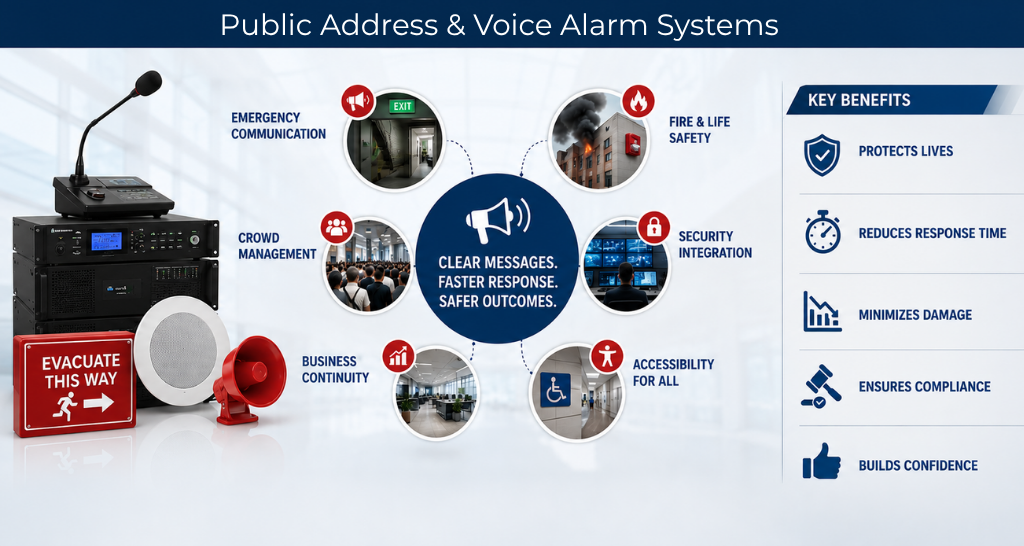
How Public Address & Voice Alarm Systems Improve Safety ?
Think about the last time you were in a large building, a shopping mall, an airport, a hospital, or a high rise office. Now imagine an emergency breaks out. A fire alarm sounds, but no one knows which exit is safe, which floor is affected, or what they should actually do. That moment of confusion can cost lives. This is exactly why Public Address & Voice Alarm systems exist and why they matter far more than most people realise. Modern Public Address & Voice Alarm technology plays a critical role in improving emergency communication and guiding occupants toward safe evacuation during critical situations.
Public Address and Voice Alarm Systems commonly known as PAVA systems are the backbone of emergency communication in modern buildings. They do more than just make noise. They deliver clear, intelligible voice instructions that cut through panic, guide people to safety, and reduce the chaos that traditional bells and buzzers simply cannot address. In this article, we’ll break down how these systems work, why they’re essential, and how they’re saving lives across industries every single day. With increasing safety standards and smart infrastructure development, Public Address & Voice Alarm solutions have become an essential component of modern building safety systems.
What Are Public Address and Voice Alarm Systems?
At their core, Public Address and Voice Alarm Systems are integrated audio communication platforms designed to serve two distinct but connected purposes: everyday announcements and life-safety emergencies. The ‘public address’ side handles routine operation,s background music in a hotel lobby, paging staff in a hospital, or gate announcements at an airport. The ‘voice alarm’ side is purpose-built for emergencies, delivering pre-recorded or live voice messages that override all other audio and guide building occupants to safety.
What separates Public Address and Voice Alarm Systems from a basic speaker setup is their certification, redundancy, and reliability. These systems are built to operate under stress. Whether a fire breaks out on the third floor of a hospital or a security threat is detected in a transport hub, PAVA systems are engineered to keep functioning even when components fail. That level of dependability is not optional. It is literally a matter of life and death.
Importance of Public Address & Voice Alarm Systems in Modern Infrastructure
Public Address & Voice Alarm systems have become an essential part of modern infrastructure where occupant safety, communication, and emergency management are critical. From commercial complexes and educational institutions to hospitals, airports, and industrial facilities, these systems help authorities deliver clear announcements in real time. During emergencies such as fire outbreaks, security threats, or evacuation situations, Public Address & Voice Alarm technology ensures that every individual inside the building receives accurate instructions without confusion. Unlike conventional alarm systems that only generate warning sounds, Public Address & Voice Alarm solutions provide voice-based communication that improves response time and reduces panic among occupants.
In smart buildings and integrated infrastructure projects, Public Address & Voice Alarm systems are now connected with fire alarms, access control, CCTV surveillance, and building management platforms for centralized operation. This integration allows security teams to respond faster and manage emergency situations more effectively. Advanced Public Address & Voice Alarm solutions also support zonal announcements, background music, multilingual messaging, and automated emergency broadcasting, making them suitable for both daily communication and critical safety operations. With increasing focus on life safety standards and intelligent building technology, investing in a reliable Public Address & Voice Alarm system has become a necessity for every modern facility.
Why Voice Instructions Beat Traditional Alarms Every Time
Here’s something most people don’t think about: when a loud, unfamiliar alarm goes off in a crowded building, the natural human response is often freeze, confusion, or even dismissal. People have become so accustomed to false alarms that many simply ignore them. Public Address & Voice Alarm system safety design specifically addresses this problem. Modern Public Address & Voice Alarm solutions are designed to deliver clear and immediate instructions that help people react quickly and safely during emergencies.
A calm, clear voice that says “Attention please, there is an emergency on floors 4 and 5. All occupants should use the nearest stairwell and proceed to the assembly point on the east side of the building” is far more effective than a generic siren. Research consistently shows that voice-based evacuation instructions reduce panic, improve compliance, and speed up evacuation times significantly. That is the core promise of Public Address & Voice Alarm system safety replacing confusion with clarity. Advanced Public Address & Voice Alarm technology ensures that emergency communication remains understandable even in noisy or crowded environments.
This approach also supports vulnerable populations. Elderly visitors, people with cognitive impairments, tourists who are unfamiliar with a building’s layout all of them benefit from direct, spoken guidance rather than an alarm that tells them nothing useful. In hospitals, airports, shopping malls, and corporate buildings, Public Address & Voice Alarm
How PA System for Building Safety Works in Practice ?
The real power of a PA system for building safety becomes obvious when you look at how it functions during an actual emergency. Most modern PAVA systems are integrated directly with fire detection and alarm infrastructure. The moment a smoke detector or heat sensor triggers, the voice alarm system responds automatically without needing a human to press a button or make a call.
Here’s what that looks like in practice. A fire is detected on the second floor of an office building. The system immediately triggers a pre-recorded evacuation message specific to that zone. The floors directly above and below receive an alert to stand by. Other floors continue with normal operations or receive a precautionary message. All of this happens within seconds automatically, calmly, and without human error.
This zonal capability is one of the defining features of a PA system for building safety. Rather than evacuating an entire building unnecessarily which creates its own risks and disruptions a well-designed PAVA system can isolate and address specific zones. This is known as phased evacuation, and it is now considered best practice in most high-occupancy buildings globally.
Key Industries That Rely on Public Address and Voice Alarm Systems
Public Address and Voice Alarm Systems aren’t just for office buildings. They are deployed across a remarkably wide range of environments, each with its own communication challenges and safety requirements.
Hospitals and Healthcare Facilities
In a hospital, clarity is everything. Patients may be immobile, staff are stretched across multiple departments, and an evacuation must be conducted without endangering the very people receiving care. Public Address and Voice Alarm Systems allow hospitals to communicate directly with specific wards, alert staff silently via paging, or initiate full-facility announcements when needed. PAVA system safety here isn’t just about fire it covers chemical spills, security threats, and mass casualty events.
Airports and Transport Hubs
Few environments are as complex as a busy international airport. Thousands of people from different countries, speaking different languages, moving through a maze of terminals and gates. Public Address and Voice Alarm Systems in airports handle everything from routine flight announcements to full-scale emergency protocols. Modern systems, like the one deployed at Warsaw’s Chopin Airport, integrate text-to-speech technology that automatically pulls flight data and delivers personalised announcements freeing staff while maintaining precision.
High Rise Office Buildings and Hotels
When you’re on the 30th floor and an alarm goes off, you need to know exactly what’s happening and where. Public Address and Voice Alarm Systems in high-rise environments are required by law in many countries and for good reason. They provide floor-by-floor communication, direct occupants to the safest exit routes, and allow building management to deliver live updates as a situation develops.
Schools and Educational Campuses
For schools, the PA system for building safety doubles as a daily operational tool and a critical emergency resource. The same system that calls students to assembly or plays the morning announcements can, within seconds, shift to a lockdown alert or evacuation instruction. The familiarity of the system’s voice in everyday use actually makes students and staff more likely to respond quickly and calmly in an emergency, Enhance visual communication with advanced Indoor LED Display solutions from Lightomated, delivering vibrant visuals, seamless performance, and smart display integration.
Standards, Compliance, and PAVA System Safety Certification
One reason PAVA system safety is taken so seriously by engineers and building managers is the regulatory framework behind it. In Europe, the EN 54 standard governs voice alarm systems, covering everything from loudspeaker performance to control equipment reliability. In North America, UL 2572 sets the benchmark for mass notification systems. These aren’t suggestions in many jurisdictions, certified Public Address and Voice Alarm Systems are a legal requirement for buildings above a certain occupancy or height.
Compliance also means regular testing and maintenance. A PA system for building safety that hasn’t been serviced is a liability, not an asset. Annual inspections, fault monitoring, and system audits are standard practice for any professionally managed PAVA installation. Many modern systems include built-in self-monitoring, flagging faults automatically so building managers can address issues before they become critical.
The Technology Driving Modern Public Address and Voice Alarm Systems
The field of Public Address & Voice Alarm systems has evolved dramatically over the past decade. IP-based Public Address & Voice Alarm solutions have replaced traditional analogue setups, bringing scalability, remote management, and seamless integration with other building technologies. Instead of running separate cabling for PA and fire alarm systems, a single IP network can now carry all safety communications with the reliability of dedicated redundancy built in. This advancement has made modern Public Address & Voice Alarm infrastructure more efficient, flexible, and easier to manage across large facilities.
Digital signal processing has also transformed audio quality. Early voice alarm systems sometimes struggled with intelligibility in acoustically challenging spaces like large atriums, underground car parks, and industrial warehouses. Modern Public Address & Voice Alarm systems use advanced DSP technology to optimize audio clarity in any environment, ensuring every emergency message is heard and understood regardless of background noise or room acoustics. These improvements have significantly enhanced communication reliability during critical situations.
Wireless PAVA systems are another growing trend, particularly useful in heritage buildings, temporary structures, or environments where cabling is impractical. These systems offer the same level of PAVA system safety as wired installations, with the added benefit of flexible deployment and easier expansion as facilities grow or change. With continuous innovation in smart building technologies, Public Address & Voice Alarm systems are becoming more intelligent, connected, and essential for modern life-safety infrastructure.
Integration: The Future of PA System for Building Safety
The most forward thinking approach to PA system for building safety today isn’t just about audio. It’s about integration. When Public Address and Voice Alarm Systems are connected to fire detection, access control, CCTV, and building management software, the result is a unified safety ecosystem that can respond to threats faster and more intelligently than any individual system could alone.
Imagine a scenario where a motion sensor detects an intruder at 2 a.m. In an integrated building, that detection immediately triggers a CCTV camera to focus on the area, locks certain access doors, alerts security personnel via their devices, and activates a targeted voice message to any staff present all without a human needing to coordinate each step. This kind of automated, layered response is what modern Public Address and Voice Alarm Systems make possible.
The market reflects this growing importance. The global Public Address and Voice Alarm Systems industry is projected to grow at a compound annual rate of 8.3% through 2032 driven by stricter safety regulations, smarter building technologies, and a global recognition that communication is the foundation of emergency response.
Why You Shouldn’t Overlook PAVA System Safety?
Safety systems are often invisible until they’re needed. Nobody walks into a shopping centre and thinks about the speaker in the ceiling until the day it calmly tells them which exit to use and keeps them from panicking. That’s the beauty of well-designed Public Address and Voice Alarm Systems: they work in the background, ready to step forward in the moments that matter most.
Whether you’re a building manager, a facilities professional, a safety officer, or simply someone who wants to understand the infrastructure keeping public spaces safe, understanding PAVA system safety is genuinely valuable. These systems are not a luxury or a technical checkbox. They are a foundational layer of how modern buildings protect the people inside them.The right PA system for building safety, properly installed, regularly maintained, and intelligently integrated, is one of the most important investments any facility can make. Because when an emergency happens and eventually, in any building, it will the difference between chaos and a calm, coordinated response often comes down to one thing: a clear voice that knows exactly what to say, Upgrade your safety infrastructure with Vallect’s advanced Public Address & Voice Alarm Systems for clear emergency communication, faster response, and secure building management.