
 admin
May 20, 2026
admin
May 20, 2026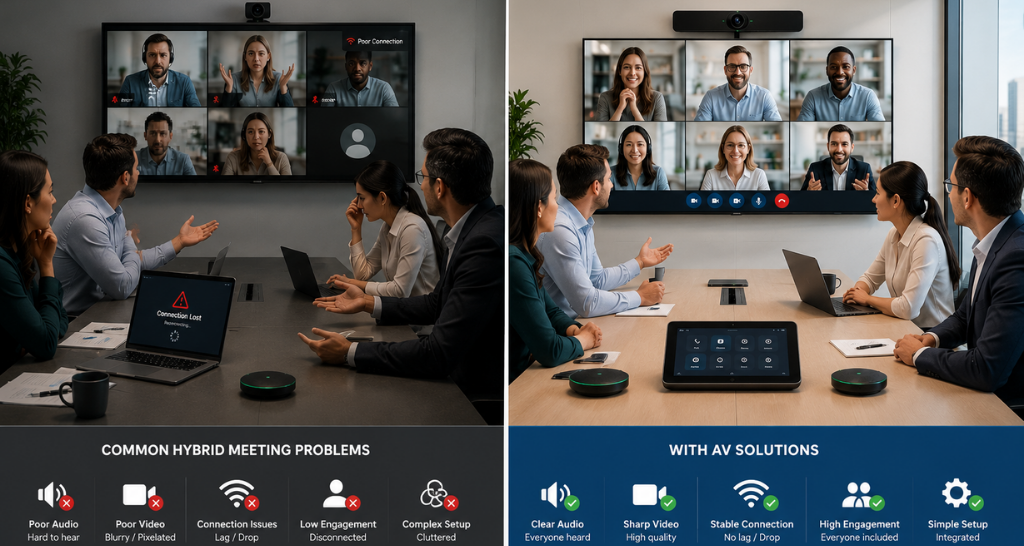
Solving the “Can You Hear Me?” Problem: AV Solutions for Hybrid Meetings
Monday morning. The meeting room is ready, the presentation is loaded, and everyone has joined. Some team members are sitting in the office conference room while others are connected remotely from different cities. The meeting starts smoothly, but within minutes the familiar sentence appears:
“Can you hear me?”
Someone on the remote side cannot hear the discussion clearly. Another participant complains about echo. A person sitting at the far end of the room sounds distant. The camera is focused on only half of the room, and remote attendees feel disconnected from the discussion.
This situation has become common in modern workplaces. Hybrid meetings are now a standard part of business operations, but without the right setup they often create communication challenges. Organizations are increasingly investing in AV Solutions for Hybrid Meetings because the quality of collaboration directly affects productivity, decision-making, and employee engagement.
The goal of modern meeting technology is not just connecting people; it is creating an experience where everyone feels equally involved regardless of location.
Why Hybrid Meetings Create Challenges
Traditional meeting rooms were designed for people sitting together in one space. Hybrid environments are different because they need to support in-room and remote participants simultaneously.
Several issues appear regularly:
- Unclear audio during discussions
- Background noise and echo
- Poor camera coverage
- Audio delay
- Microphone placement problems
- Communication gaps between remote and in-office participants
These are among the most common Hybrid Meeting Audio Problems organizations face today.
When remote attendees constantly ask for repeated information, meeting flow breaks down and productivity decreases. That is why businesses now look toward smarter AV Solutions for Hybrid Meetings to create a seamless experience.
The Real Cost of Poor Meeting Experiences
Many organizations think meeting issues are small technical inconveniences. In reality, they affect efficiency in multiple ways.
Poor meeting experiences can lead to:
- Miscommunication
- Reduced employee participation
- Longer meeting times
- Delayed decisions
- Lower engagement
- Reduced customer confidence during external meetings
This is where advanced Conference Room AV Systems become important because they transform communication quality and user experience.
A good meeting should feel natural rather than technical.
Problem 1: Unclear Voice Communication
Imagine a manager speaking from one end of the room while remote participants struggle to understand every sentence. The microphone captures some voices well but misses others completely.
This issue is one of the biggest Hybrid Meeting Audio Problems in organizations today.
Solution: Beamforming Microphones
Modern microphone systems use beamforming technology to automatically detect and capture voices from different directions.
Benefits include:
- Better voice pickup
- Reduced need for multiple microphones
- Consistent sound quality
- Improved coverage across larger spaces
These intelligent microphones are becoming an essential part of AV Solutions for Hybrid Meetings because they ensure that every participant can be heard clearly.
Businesses implementing smart microphone technology often include them within their Hybrid Meeting Room Solutions strategy.
Problem 2: Echo and Background Noise
Typing sounds, air conditioners, hallway conversations, and room reflections often create distractions.
When sound bounces around a room, participants experience echo and audio distortion.
These issues are among the most frustrating Hybrid Meeting Audio Problems because they affect both understanding and concentration.
Solution: DSP Technology
Digital Signal Processors (DSPs) are designed to manage and improve audio quality.
DSP systems can:
- Remove echo
- Reduce background noise
- Balance sound levels
- Improve voice clarity
- Process audio in real time
DSP technology has become one of the most important AV Solutions for Hybrid Meetings because it improves communication without requiring users to manually adjust settings.
Many modern Conference Room AV Systems rely on DSP integration to create clean and professional audio experiences.
Problem 3: Camera Quality Issues
Audio is important, but video also plays a major role.
Remote participants often experience:
- Blurry video
- Poor room coverage
- Fixed camera angles
- Difficulty identifying speakers
When people cannot clearly see the room or participants, they feel disconnected.
Solution: Intelligent Camera Systems
AI-powered cameras are changing the meeting experience.
These cameras provide:
- Auto framing
- Speaker tracking
- Wide-angle room coverage
- Intelligent participant focus
Smart cameras are becoming key Hybrid Meeting Room Solutions because they allow remote attendees to feel present during discussions.
Organizations deploying AV Solutions for Hybrid Meetings increasingly use intelligent camera technology to improve engagement.
Problem 4: Communication Gap Between Remote and In-Room Teams
A common issue in hybrid environments is that in-office participants naturally interact more with each other while remote attendees become passive listeners.
This creates an unequal meeting experience.
Modern Conference Room AV Systems help bridge this gap by ensuring every participant receives equal visibility and audio quality.
Solution: Collaboration Platforms with AV Integration
Integrated meeting environments combine:
- Video conferencing platforms
- Display systems
- Cameras
- Audio processors
- Wireless sharing technology
These Hybrid Meeting Room Solutions create a collaborative environment where participants interact naturally.
Businesses adopting AV Solutions for Hybrid Meetings often discover improvements in team engagement and meeting participation.
Problem 5: Poor Speaker and Microphone Placement
Sometimes organizations purchase quality equipment but install it incorrectly.
Common setup issues include:
- Speakers placed too close to microphones
- Limited microphone coverage
- Uneven audio distribution
- Dead audio zones
These installation mistakes contribute significantly to Hybrid Meeting Audio Problems.
Solution: Proper Room Design and System Integration
Professional AV planning focuses on:
- Room size
- Seating arrangement
- Acoustic treatment
- Device positioning
- User workflow
Integrated Conference Room AV Systems ensure all technologies work together rather than operating independently.
Proper planning is one of the most overlooked AV Solutions for Hybrid Meetings but often delivers major improvements.
Products That Support Better Hybrid Meetings
Technology products work best when they operate together as one ecosystem.
Intelligent Microphones
These capture voices accurately and reduce unwanted noise.
Benefits:
- Clear communication
- Better participant experience
- Reduced interruptions
They are a common component of modern Hybrid Meeting Room Solutions.
DSP Audio Processors
DSP systems manage sound quality automatically.
Benefits:
- Echo cancellation
- Noise reduction
- Balanced audio output
They help reduce recurring Hybrid Meeting Audio Problems.
PTZ and AI Cameras
Pan-Tilt-Zoom cameras and AI cameras improve visibility.
Benefits:
- Better participant tracking
- Improved visual engagement
- Wider room coverage
Organizations implementing AV Solutions for Hybrid Meetings frequently choose smart camera technologies.
Interactive Displays
Displays allow teams to share content and collaborate effectively.
Benefits:
- Better presentation experiences
- Easy annotation
- Real-time collaboration
These displays strengthen Conference Room AV Systems by creating interactive workspaces.
Benefits of Investing in Hybrid Meeting Technology
Businesses implementing advanced AV Solutions for Hybrid Meetings often notice measurable improvements.
Key benefits include:
Improved Productivity
Meetings become more efficient because participants spend less time solving technical issues.
Better Communication
Clear audio and video reduce misunderstandings.
Stronger Collaboration
Modern Hybrid Meeting Room Solutions create equal experiences for all participants.
Increased Employee Engagement
Remote employees feel more involved during discussions.
Professional Client Experience
High-quality Conference Room AV Systems improve communication with clients and partners.
Important Factors Before Choosing AV Solutions
Not every meeting room requires identical technology.
Before selecting equipment, consider:
Room Size
Large rooms may require multiple microphones and cameras.
Number of Participants
Meeting capacity affects equipment requirements.
Platform Compatibility
Ensure systems work with meeting platforms and collaboration tools.
Scalability
Future growth should be considered.
Ease of Use
Complex systems often create additional frustration.
Businesses planning AV Solutions for Hybrid Meetings should focus on usability alongside performance.
The most successful Hybrid Meeting Room Solutions are often the ones people can use without technical assistance.
Building the Future of Hybrid Collaboration
The sentence “Can you hear me?” may sound simple, but it often highlights deeper technology challenges.
As organizations continue adopting flexible work environments, meeting rooms need to evolve beyond traditional setups.
Modern AV Solutions for Hybrid Meetings are no longer optional upgrades; they are becoming critical business tools.
From intelligent microphones and AI cameras to DSP technology and integrated collaboration platforms, organizations now have access to technologies that solve recurring Hybrid Meeting Audio Problems and create better experiences.
The goal is not simply to make meetings work and Video wall displays deliver dynamic visuals, real-time information, and engaging content experiences that improve communication, collaboration, and audience engagement.
The goal is to create meeting spaces where people communicate naturally, collaborate efficiently, and stay connected regardless of where they are located.