
 admin
June 1, 2026
admin
June 1, 2026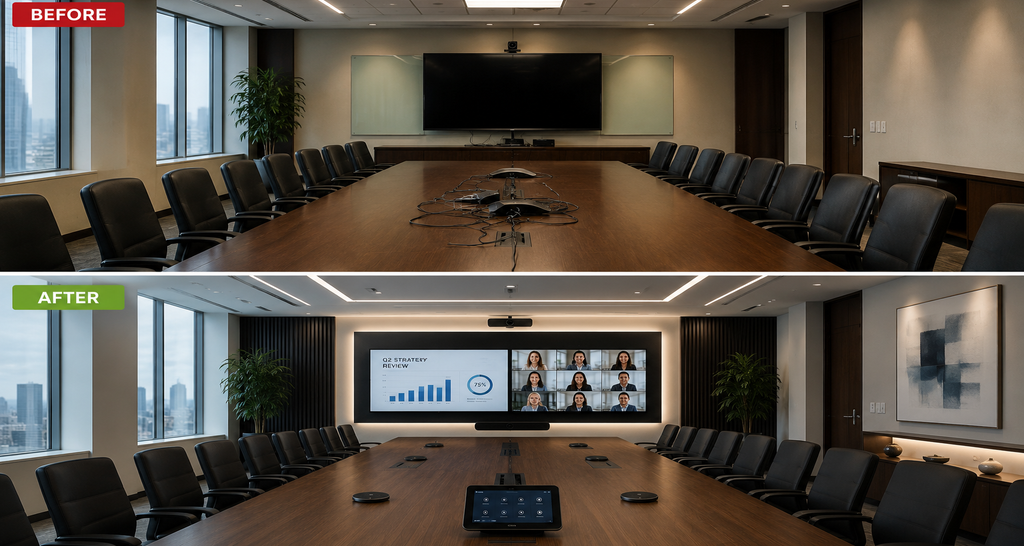
Eliminating Meeting Room Failures Through Strategic Audio Visual Integration
Organizations today spend heavily on meeting room technology, yet employees continue to face recurring issues:
- Microphones not capturing voices clearly
- Video conferencing delays and connectivity failures
- Display sharing problems
- Echo, audio distortion, and background noise
- Multiple remotes and confusing controls
- Hybrid participants feeling disconnected
The problem is rarely the equipment itself.
Most meeting room failures occur because organizations purchase individual devices rather than designing a complete collaboration ecosystem. A premium camera cannot compensate for poor acoustics. A large display cannot solve content-sharing delays. A powerful microphone cannot fix bad signal routing.
This is where strategic Audio Visual Integration becomes critical. Instead of deploying disconnected technologies, AV integration creates a unified environment where displays, microphones, cameras, speakers, control systems, collaboration platforms, and network infrastructure work together seamlessly.
For modern enterprises, the objective is no longer installing AV hardware. The objective is eliminating friction from communication.
Understanding the Root Causes of Meeting Room Failures
Before discussing solutions, organizations must understand the root causes behind poor meeting experiences.
Failure #1: Technology Purchased in Silos
Many meeting spaces evolve over time.
A display is added one year.
A video conferencing camera is added later.
Wireless presentation tools arrive afterward.
Audio systems are upgraded separately.
Eventually, the room contains multiple technologies that were never designed to work together.
The result is:
- Compatibility issues
- Complex user experiences
- Frequent troubleshooting
- Increased support tickets
Strategic AV integration eliminates these silos by designing the room as a complete ecosystem from the beginning.
Failure #2: Audio Design Is Treated as an Afterthought
Most organizations focus heavily on displays and cameras.
However, meeting participants can tolerate mediocre video much more easily than poor audio.
If attendees cannot hear clearly, collaboration immediately breaks down.
Common issues include:
- Echo
- Reverberation
- Dead zones
- Uneven sound coverage
- Background noise
Industry experts increasingly emphasize that audio quality is the foundation of productive collaboration environments. Intelligent microphones, DSP processing, and acoustic planning have become essential components of modern meeting room design.
Failure #3: Hybrid Meetings Were Never Considered
Traditional conference rooms were built for in-person discussions.
Today’s workplaces require:
- Remote participants
- Distributed teams
- Cross-location collaboration
- Flexible work models
Without strategic AV planning, remote attendees become passive observers rather than active contributors.
Meeting equity becomes impossible.
Modern AV systems must be designed specifically for hybrid collaboration experiences.
Failure #4: Poor User Experience
A meeting room should not require technical expertise.
Yet many spaces still require users to:
- Select inputs manually
- Configure audio devices
- Launch conferencing systems
- Switch displays
- Adjust microphones
Every additional step increases the likelihood of failure.
Successful meeting rooms prioritize simplicity through centralized control and automation.
Importance of AV Integration in Corporate Meeting Rooms
Strategic AV integration is essential in modern meeting rooms because it ensures that communication systems are aligned with workplace needs from the beginning. Instead of treating AV as an add-on, it becomes a core part of design strategy. This approach improves collaboration between on-site and remote teams, reduces operational issues, and enhances the overall meeting experience. It also supports scalable infrastructure that adapts to future technological upgrades and hybrid work models.
Key Points:
- Enables smooth communication
- Supports hybrid work culture
- Reduces technical failures
- Improves user experience
Key AV Technologies Powering High-Performance Corporate Meeting Rooms
High-performance meeting rooms rely on advanced AV technologies that deliver seamless communication and reliability. These include intelligent cameras, high-quality audio systems, and network-based distribution systems. When combined, they create a unified ecosystem that supports crystal-clear meetings and smooth collaboration across locations. Modern solutions also integrate cloud-based conferencing platforms and automation tools, making room usage more efficient and user-friendly.
Key Points:
- PTZ and AI cameras
- Beamforming microphones
- Digital signal processors
- AV-over-IP systems
- Unified conferencing platforms
User-Centric Meeting Rooms with Seamless Technology
Modern meeting spaces increasingly rely on integrated technologies rather than standalone devices.
Intelligent Audio Systems
Including:
- Beamforming microphones
- DSP processing
- Echo cancellation
- Noise suppression
These technologies ensure every participant can be heard clearly regardless of room size.
AI-Enabled Cameras
Features include:
- Auto framing
- Speaker tracking
- Intelligent participant recognition
This improves engagement for remote attendees and creates more natural hybrid meetings.
Wireless Content Sharing
Employees expect instant presentation sharing from:
- Laptops
- Tablets
- Mobile devices
Without cables or adapters.
Unified Collaboration Platforms
Integration with:
- Microsoft Teams
- Zoom
- Google Meet
ensures consistent meeting experiences across locations.
Centralized Control Systems
Providing:
- One-touch meeting start
- Automated room configuration
- Device monitoring
- Simplified user experience
Role of AV Integration in Creating Seamless Meeting Experiences
AV integration acts as the central backbone of modern meeting rooms by connecting all technologies into a single, manageable system. It ensures that audio, video, lighting, and control systems work in harmony without user complexity. This reduces setup time, improves meeting flow, and creates a more intelligent and responsive environment. It also allows organizations to standardize their meeting room experience across multiple locations and High-resolution LED Video Walls deliver stunning visuals, vibrant colors, and seamless display performance. Ideal for events, retail stores, corporate spaces, and advertising..
Key Points:
- Unifies AV systems
- Simplifies control interface
- Enhances collaboration flow
- Improves system efficiency
Impact of AV Integration on Productivity, Communication, and Workplace Efficiency
Integrated AV systems significantly improve workplace productivity by minimizing technical disruptions and enhancing communication clarity. Teams can focus more on discussions rather than managing equipment. It also reduces downtime and ensures faster decision-making in hybrid meetings. Over time, this leads to better collaboration outcomes, higher employee satisfaction, and improved operational efficiency across the organization.
Key Points:
- Boosts productivity
- Reduces downtime
- Enhances meeting quality
- Improves decision-making speed
How Vallect Helps Build Seamless AV Integration Ecosystems
Vallect delivers end-to-end AV integration by combining audio, video, control, and networking systems into a unified, future-ready ecosystem. It ensures smooth communication, scalable infrastructure, and reliable performance across enterprise environments.
From design to deployment, Vallect creates intelligent meeting spaces that reduce complexity, improve collaboration, and enhance user experience for corporate offices, campuses, and modern hybrid workplaces.