
 admin
June 3, 2026
admin
June 3, 2026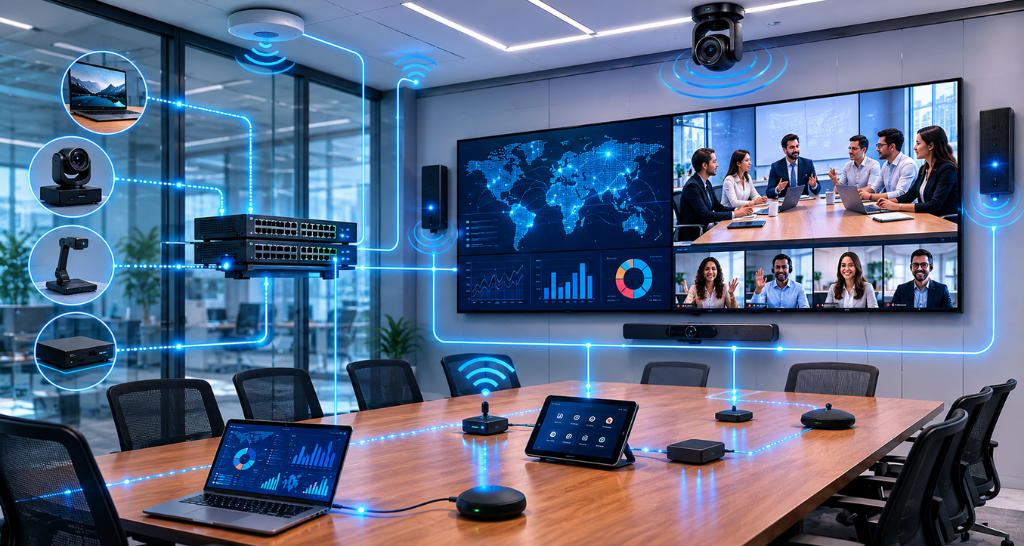
The Rise of AV-over-IP: Transforming Enterprise Communication Infrastructure
Enterprises today are scaling faster than ever, but their communication infrastructure is struggling to keep up. The biggest issue? Legacy AV systems.
Traditional setups rely heavily on point-to-point cabling, rigid hardware dependencies, and limited scalability. This creates a bottleneck when organizations try to expand meeting rooms, hybrid collaboration spaces, or global conferencing environments.
This is exactly where AV-over-IP is reshaping the entire ecosystem.
Unlike conventional systems, AV-over-IP transmits audio, video, and control signals over standard IP networks, enabling flexibility, scalability, and centralized management. It is not just an upgrade it is a complete shift in how enterprise communication infrastructure is designed.
What Makes AV-over-IP a Turning Point in Enterprise Communication Infrastructure?
To understand the shift, we need to look at how AV-over-IP infrastructure changes the architecture itself.
Instead of using proprietary cables and matrix switchers, AV-over-IP infrastructure leverages existing network switches to distribute high-quality audio and video signals across multiple endpoints.
This means:
- Meeting rooms can be added without rewiring
- Devices can be centrally controlled
- Content can be shared across buildings or even globally
- Infrastructure becomes software-driven instead of hardware-limited
Modern enterprises are adopting AV-over-IP technology because it aligns with IT-first environments rather than AV-isolated systems.
This convergence of AV and IT is one of the strongest drivers behind the rise of AV-over-IP technology in corporate ecosystems.
How Does AV-over-IP Technology Actually Work?
At its core, AV-over-IP technology converts audio and video signals into digital packets. These packets travel through standard network infrastructure and are decoded at the destination display or speaker system.
In practical enterprise setups, this includes:
- Encoder devices (capture sources like cameras, laptops)
- Network switches (carry data streams)
- Decoder devices (display outputs on screens or projectors)
This architecture enables real-time distribution across large environments such as corporate campuses, education institutions, and command centers.
A properly designed AV-over-IP infrastructure also integrates QoS (Quality of Service), VLAN segmentation, and low-latency streaming protocols to ensure performance consistency.
Leading OEMs like Crestron, Extron, AMX, and Barco have developed advanced ecosystems that support scalable AV-over-IP deployment models for enterprise-grade environments.
End-to-End Workflow of AV-over-IP Systems:
1 – Encoders convert AV signals into IP streams
2 – IP streams are transmitted through network switches/routers
3 – Network (with QoS + VLAN) manages and prioritizes AV traffic
4 – Decoders receive the IP streams from the network
5 – Decoders convert streams back into AV signals
6 – Output devices display/play the final content in real time
Enterprises Are Shifting Toward AV-over-IP Deployment Models
The shift toward AV-over-IP deployment is not just a trend it is a response to real operational challenges.
Enterprises today require:
- Hybrid meeting compatibility
- Centralized AV management
- Remote troubleshooting
- Scalable room expansion
- Cost-efficient infrastructure upgrades
Traditional AV systems fail to support these requirements without expensive retrofitting.
However, AV-over-IP deployment allows organizations to build modular systems that grow with their needs.
For example:
- A company can start with 5 conference rooms and expand to 50 without redesigning the entire system
- Global offices can share real-time content seamlessly
- IT teams can manage AV systems just like network devices
This flexibility is why AV-over-IP deployment is rapidly becoming the backbone of enterprise collaboration environments.
the Problems AV-over-IP Solving in Conference Room Integration
One of the most impactful applications is AV-over-IP conference room integration.
Modern conference rooms are no longer simple meeting spaces they are hybrid collaboration hubs. Employees connect from multiple devices, platforms, and locations.
But traditional AV setups create challenges like:
- Audio-video sync issues
- Limited device compatibility
- Complex switching systems
- Poor scalability across multiple rooms
AV-over-IP conference room integration solves these issues by creating a unified digital backbone.
With this approach:
- Cameras, microphones, and displays communicate over IP
- Meetings can be routed to any room instantly
- Content sharing becomes device-agnostic
- Systems can be monitored remotely
This is especially powerful in enterprises with global teams, where AV-over-IP conference room integration ensures seamless collaboration regardless of location and indoor led video wall delivers high-impact visuals for corporate spaces, retail, events, and control rooms, offering seamless display, clarity, and scalable digital communication solutions.
Where Does AV-over-IP Make the Biggest Impact Across Industries?
The adoption of AV-over-IP technology is accelerating across multiple sectors:
Corporate Enterprises
Large organizations use AV-over-IP infrastructure for boardrooms, training centers, and hybrid collaboration spaces.
Education Sector
Universities deploy AV-over-IP deployment systems for lecture streaming and multi-campus learning environments.
Healthcare
Hospitals use it for telemedicine, surgical broadcasting, and real-time monitoring systems.
Government & Command Centers
Secure, scalable AV-over-IP infrastructure supports mission-critical communication environments.
Across all these sectors, AV-over-IP conference room integration ensures consistent communication quality and centralized control.Enterprises are no longer asking whether to adopt AV-over-IP they are deciding how fast they can transition.
The reasons are clear:
- Lower long-term infrastructure costs
- Higher scalability
- IT-friendly architecture
- Cloud and hybrid compatibility
- Simplified maintenance
As organizations modernize, AV-over-IP technology becomes the foundation for digital workplaces.
Whether it’s boardroom communication or global conferencing, AV-over-IP conference room integration ensures consistency and reliability.
How Vallect Helps in Building Future-Ready AV-over-IP Ecosystems
Modern AV transformation requires more than just hardware, it needs strategic design, integration, and execution.
At Vallect, the focus is on building intelligent AV-over-IP infrastructure tailored for enterprise communication needs.
From planning to AV-over-IP deployment, systems are designed to ensure:
- Seamless scalability
- Optimized network performance
- OEM-compatible integration
- Future-ready architecture
Whether it’s corporate offices, educational institutions, or enterprise campuses, AV ecosystems are engineered for long-term efficiency and adaptability.