
 admin
August 17, 2026
admin
August 17, 2026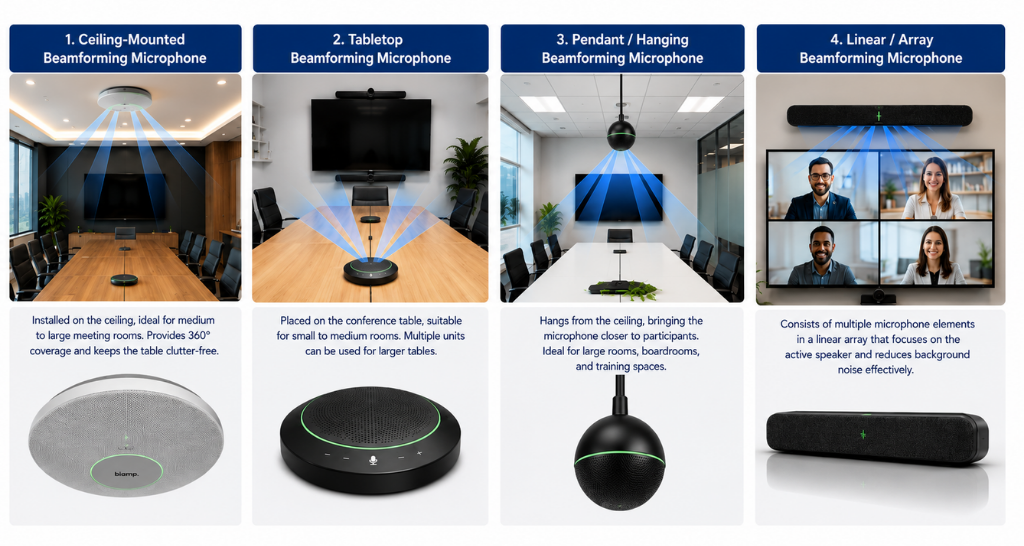
Beamforming Microphones in Video Conferencing Systems: How They Work
“Can you hear me?”
“Please speak closer to the microphone.”
“Your voice is breaking.”
These are common interruptions in meetings when voice pickup is not properly planned. A participant may be sitting several feet away from the microphone, while another person may be sitting closer to it. Someone at the end of a long conference table may sound quieter, while background conversations or room noise can make speech harder to understand.
A well-designed Video Conferencing System depends heavily on clear voice pickup. Even when the video looks excellent, poor microphone performance can make a meeting frustrating for everyone involved.
This is where beamforming microphones become useful. Instead of relying on a single microphone’s pickup pattern, a beamforming microphone uses multiple microphone elements and signal processing to focus on sound coming from specific directions.
The result is a microphone designed to provide more controlled and consistent voice pickup across a defined area.
What Happens Without a Beamforming Microphones in video Conferencing System?
Before understanding beamforming, it helps to understand the limitations that can occur without it.
In a basic meeting setup, microphone placement can have a major impact on how clearly participants are heard. A person sitting close to the microphone may sound clear, while someone farther away may sound quieter.
This becomes more noticeable when:
- Several people are sitting around a large table
- Participants are seated at different distances from the microphone
- Seating arrangements change frequently
- Speakers move while talking
- Unwanted sounds are present around the room
- Participants need to lean toward the microphone to be heard
In these situations, a conventional microphone may still work perfectly well for its intended application, but it may not provide the directional flexibility required by larger or more dynamic meeting spaces.
For businesses that depend on a Video Conferencing System for daily communication, inconsistent voice pickup can affect the entire meeting experience.
Common Problems Without Proper Directional Voice Pickup:
Uneven voice levels:
People sitting at different positions may not be picked up equally.
Limited flexibility:
Participants may need to remain within a particular microphone pickup area.
Unwanted sound pickup:
Sounds coming from outside the intended speaking area can also reach the microphone.
Interrupted conversations:
Remote participants may repeatedly ask speakers to repeat themselves.
Poor meeting experience:
When participants have to focus on microphone placement instead of the discussion, meetings become less natural.
This does not mean that every meeting requires beamforming. The microphone technology should always match the room, seating arrangement, and application.
What Is a Beamforming Microphones?
A beamforming microphone is a microphone system that uses multiple microphone elements arranged in an array to determine the direction from which sound is arriving and prioritize sound from the desired direction.
In simple words, instead of treating sound from every direction equally, the microphone uses multiple pickup points and processing to create a more focused listening area.
Think of it like a flashlight.
A normal light source can illuminate a broad area, while a flashlight directs light toward a particular area. Similarly, Indoor LED Video Wall technology focuses visual content, while beamforming applies the same concept to sound through microphone arrays and signal processing.
A beamforming microphone generally consists of:
- Multiple microphone elements
- A microphone array
- Directional signal processing
- Beamforming algorithms
- Defined pickup zones
- Connectivity and control interfaces
The exact architecture varies between manufacturers and models, but the underlying principle remains the same: use multiple sound-capture points to understand where sound is coming from and focus on the desired voice.
How Does Beamforming Microphones Work Video Conferencing System?
The working principle can be understood through a simple sequence:
Speaker → Microphone Array → Sound Direction Analysis → Beamforming Processing → Focused Voice Output
Let’s break it down.
1. Multiple Microphone Elements Capture Sound
Unlike a simple single-capsule microphone, a beamforming microphone contains multiple microphone elements.
Each element captures the sound reaching it.
When someone speaks, the sound does not reach every microphone element at exactly the same time or with exactly the same intensity. The differences depend partly on the speaker’s location relative to the array.
2. The Microphone Detects Differences in the Sound
The microphone system analyzes the signals captured by its different elements.
For example, if a person is speaking from the left side of the microphone, the sound may reach certain elements slightly before others.
These differences provide information about the approximate direction of the sound source.
3. The System Creates a Directional Focus
The beamforming process uses the information from the microphone elements to emphasize the desired direction.
Instead of treating every incoming sound equally, the system can create a focused pickup area.
This directional focus is commonly referred to as a beam.
The microphone can be designed to steer or adjust this beam depending on its technology and configuration.
4. Unwanted Directions Can Be Reduced
Once the desired sound direction is identified, sound arriving from other directions can be reduced depending on the microphone’s design and processing capabilities and Video Conferencing System.
This can help improve voice separation in environments where multiple sounds are present.
However, beamforming should not be misunderstood as a universal noise-removal technology. Its primary role is directional sound pickup.
5. The Focused Voice Is Sent to the Meeting System
After processing, the resulting audio signal is sent to the connected Video Conferencing System.
The remote participant receives a more focused representation of the speaker’s voice, assuming the microphone has been correctly selected, installed, and configured.
| Without Beamforming | With Beamforming |
|---|---|
| Pickup depends strongly on microphone pattern and placement | Pickup can be directionally focused |
| Speaker position may have greater impact | Speaker direction can be prioritized |
| Coverage may require more careful positioning | Coverage can be planned around defined areas |
| Unwanted sounds may be captured | Other directions can potentially be reduced |
| Less flexibility in some room layouts | Greater flexibility for suitable applications |
| May work well for simple rooms | Particularly useful for complex meeting spaces |
The important point is not that beamforming makes every microphone obsolete.
Instead, beamforming becomes valuable when directional control and flexible voice pickup are important requirements.
How Beamforming Microphones Improves Voice Pickup in Video Conferencing System?
1. Directional Focus
Beamforming allows the microphone to focus on a particular sound direction rather than treating the entire surrounding area equally.
This can be especially useful when participants are distributed around a large meeting table.
2. Flexible Seating
In a well-designed setup, participants may be able to speak from different positions without needing to move directly toward a microphone.
3. Wider Coverage Options
Multiple microphone elements allow manufacturers to design systems capable of covering defined areas within a room.
4. Better Voice Consistency
A properly designed microphone setup can help reduce differences in voice pickup between participants located at different positions.
5. Reduced Unwanted Sound Pickup
Because the system can prioritize certain directions, sounds arriving from other areas may be reduced and Video Conferencing System.
The effectiveness depends on the microphone design, room acoustics, installation position, and surrounding environment.
Beamforming Microphones Does Not Mean Noise Cancellation :
This is an important distinction in Video Conferencing System.
People often assume that beamforming and noise cancellation are the same technology. They are not.
Beamforming
Primarily focuses on where sound is coming from Video Conferencing System.
Noise Suppression
Works to reduce unwanted background sounds.
Echo Cancellation
Helps prevent audio from speakers being picked up again by the microphone.
Therefore, a beamforming microphone should not be described as a device that automatically eliminates every type of background noise.
Its main advantage is spatial or directional control of sound pickup in Video Conferencing System.
Where Are Beamforming Microphones Useful?
Beamforming microphones can be used in different meeting environments where participants need flexible and consistent voice pickup.
Conference Rooms
Conference rooms often have multiple participants seated around a table. A beamforming microphone can help provide directional coverage across the intended seating area and Video Conferencing System.
Boardrooms
Long boardroom tables can create significant differences in microphone distance. Beamforming technology can be useful when participants need to speak naturally from different positions and Video Conferencing System.
For larger executive spaces, a properly planned Video Conferencing Solution for Board rooms can help ensure suitable microphone coverage and consistent voice pickup.
Huddle Rooms
Smaller collaboration spaces can benefit from compact beamforming solutions that capture voices clearly from different positions around the table. This helps ensure consistent audio quality without requiring participants to sit close to a fixed microphone.
Training Rooms
Training rooms often have flexible seating arrangements, with participants and speakers moving frequently. Directional microphone coverage helps capture voices clearly from changing positions, ensuring consistent audio quality throughout the session without relying on fixed microphone placement.
Large Meeting Spaces
Larger rooms may require carefully planned microphone coverage zones. Multiple beamforming microphones can be positioned according to the room’s dimensions and seating layout.
Common Mistakes When Using Beamforming Microphones :
Ignoring Room Layout : A technically capable microphone can still perform poorly if its placement does not match the seating arrangement.
Assuming Beamforming Removes Every Noise : Beamforming provides directional control, but it does not automatically eliminate every unwanted sound.
Ignoring Acoustics : Room reflections can affect speech clarity regardless of microphone technology.
Using the Same Setup for Every Room : A huddle room, boardroom, and training room have different microphone requirements.
Not Testing the Complete Coverage Area : Every expected speaker position should be tested after installation to confirm that voice pickup meets the requirement.
When Should You Upgrade to Beamforming Microphones?
A beamforming microphone upgrade can be worth considering when the existing microphone setup is creating recurring voice-pickup problems.
Consider upgrading when in Video Conferencing System:
- Participants frequently ask others to repeat themselves
- People have to move closer to microphones while speaking
- Participants at the end of a table sound significantly quieter
- Seating arrangements change frequently
- Multiple people need to speak naturally from different positions
- Unwanted sound pickup is affecting conversations
- Existing microphones do not provide the required coverage
- The organization is upgrading its Video Conferencing System
The purpose of an upgrade should not simply be to adopt newer technology. The objective should be to solve a clearly identified voice-pickup requirement.
How Vallect Helps ?
Choosing and installing a beamforming microphone requires more than selecting a product from a catalogue and Video Conferencing System.
Vallect can assess the meeting environment and help determine the appropriate microphone approach based on:
- Room dimensions
- Seating arrangement
- Participant capacity
- Required voice coverage
- Ceiling height
- Installation conditions
- Acoustic environment
- Microphone placement
- Coverage zones
For organizations planning TOP AV Integration in delhi, professional planning can help ensure that microphone technology is matched to the actual room requirements.
For executive spaces, a properly planned Video Conferencing system, board rooms can incorporate suitable beamforming microphone configurations according to seating and room requirements.
The focus is simple: select the right beamforming microphone, position it correctly, test its coverage, and configure it according to the room’s actual usage.
Key Takeaways
Beamforming microphones are designed to provide more controlled voice pickup by using multiple microphone elements and directional processing.
The technology can be particularly useful when:
- Participants sit at different distances
- Flexible seating is required
- A large table needs broad voice coverage
- Directional voice pickup is important
- Traditional microphone placement creates limitations
Vallect can also support the broader Unified Communication and Collaboration environment where microphone performance plays an important role in everyday communication.
However, beamforming is not a magic solution for every audio problem. Performance depends on the microphone design, room acoustics, placement, coverage requirements, and installation quality and Video Conferencing System.
The right approach is to first understand the voice-pickup problem and then select a microphone technology that addresses it.