
 admin
May 6, 2026
admin
May 6, 2026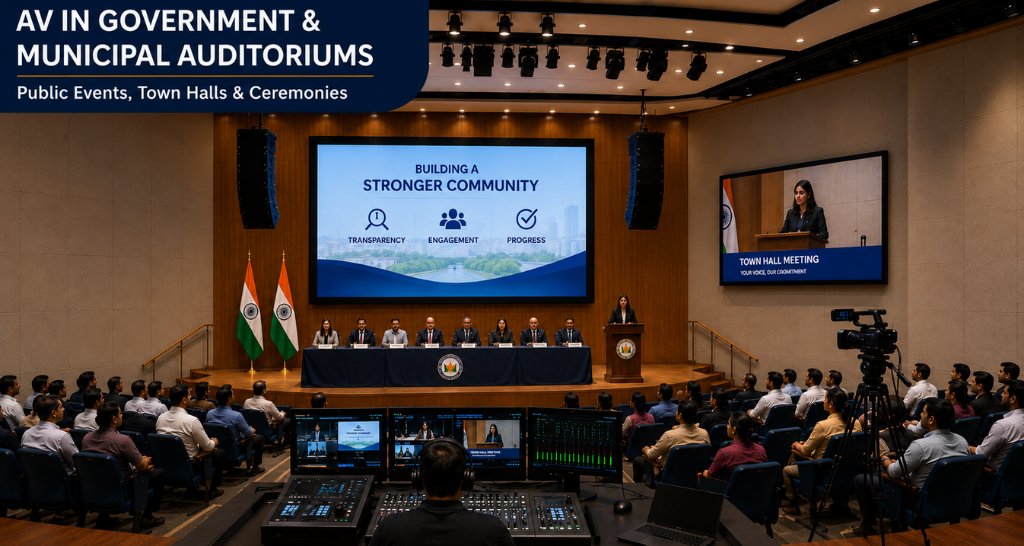
Auditorium AV for Government & Municipal Spaces : Public Events, Town Halls & Ceremonies
Government and municipal institutions serve one of the most demanding audiences in the world, the public. Town hall, civic ceremony, legislative proceeding, or public grievance hearing, every word must be heard clearly, every speaker must be seen precisely, and every event must be recorded with absolute reliability.
This is why auditorium AV in government spaces is not simply a technical requirement, it is a democratic necessity. When auditorium AV systems underperform in public venues, the consequences extend beyond inconvenience. Citizens lose trust, officials lose credibility, and the institutional purpose of the event is undermined.
Modern auditorium AV deployments are changing the way public institutions communicate, engage and operate through government and municipal facilities. This article discusses the technology, applications and best practices that define high-performance AV in government auditoriums today.
Unique Needs of Government Auditorium AV
AV in government auditoriums is very different than corporate or education deployments. Requirements are driven by:
- Size: Municipal auditoriums are generally multi-tiered and have capacities from 300 to over 2,000
- Accessibility: Hearing loops, assistive listening systems and captioning support are required by law.
- Accountability: Proceedings must be recorded to broadcast-quality standards for archival and public transparency
- Security: Restrict access to AV feeds, secure signal routing for sensitive sessions
- Reliability: Zero tolerance for system failure during live public events
These factors make auditorium AV for government facilities a specialty discipline requiring deep integration expertise rather than off-the-shelf hardware installation.
Key AV Applications in Government Settings for Auditoriums :
1. Town halls and public meetings
Town halls are some of the most acoustically challenging uses of auditorium AV. Attendees speak from various positions in the room, including podiums, floor microphones and seated positions. Everyone present must be able to hear the moderator and panel clearly.
AV for government auditoriums for town halls usually includes:
- Distributed speaker arrays to provide uniform sound coverage throughout all seating zones
- Automatic microphone mixing (AMX) to avoid feedback and control simultaneous inputs
- PTZ cameras to provide multiple angles of the dais, floor speakers and audience responses
- Live captioning for accessibility and transparency
- Hybrid streaming infrastructure to reach citizens who can’t attend in person
2. Meetings of the Legislative and Council Chamber
The most formal application of auditorium AV in the government sector is in council chambers and legislative halls. Everything said must be accurately recorded, attributed and archived.
AV in government auditoriums at this level consists of:
- Individual desk microphone for each member delegate conferencing system
- Large screens for real-time vote counts
- Multi-camera recording suites for official session archives
- Simultaneous interpreting systems for multilingual councils and international delegations.
- Digital agenda and agenda management displays incorporated into chamber AV network
3. Civic Ceremonies and Award Functions
Republic Day, Independence Day, award ceremonies, and other civic felicitation events call for auditorium AV equipment that can ensure maximum impact and accuracy. This is a very visible event whose technical glitches cannot be tolerated.
The basic elements of the auditorium AV equipment used for ceremonies are:
- Large format LED video walls to enhance the visual impact and also to give live view of the proceedings on stage
- Line array speaker systems to get coverage in large open or semi open areas
- Stage wash and intelligent lighting, which is synchronized with AV operations
- Live recording and broadcast systems
4. Public Grievance Hearings and Tribunal Proceedings
Public hearings, tribunals, and inquiries by commissions need AV for government auditoriums, which is designed keeping in mind clear sound, documentations, and security. Everything said and done will have a bearing in the matter being dealt with.
The key components in AV equipment used for this purpose are:
- Boundary and gooseneck microphones on all witnesses and members of the panel
- Audio recording system capable of capturing multiple tracks on an individual basis
- Evidence display system with HDMI connectivity to show videos, photos, documents, etc.
Core Technology Components of Government Auditorium AV :
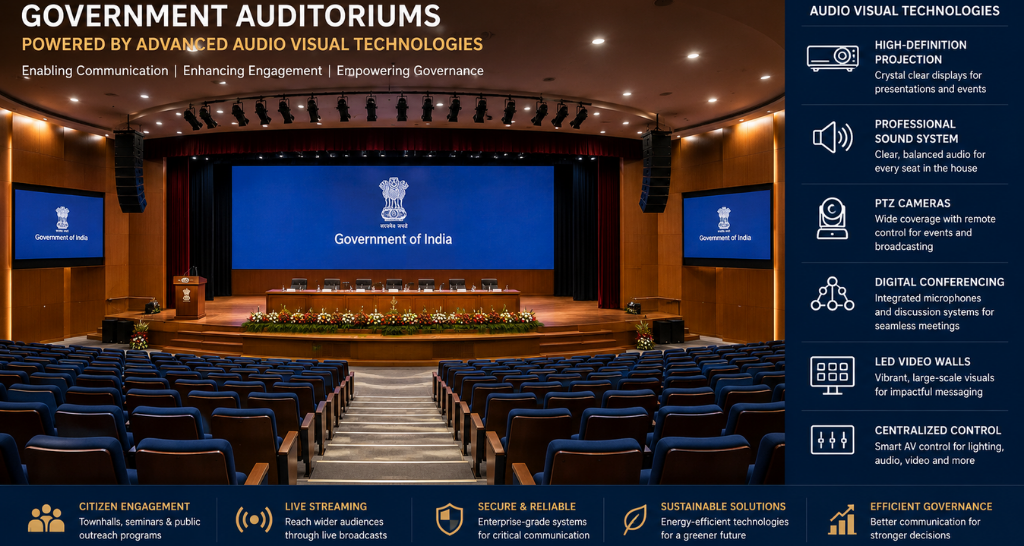
Acoustic Design and Speaker Systems :
Government auditorium AV starts with acoustic design. Government auditoriums commonly have hard reflective surfaces like marble floors, high ceilings, and concrete walls, which cause reverberations and echoes. Professional auditorium AV installations counteract this with:
- Acoustic simulation software (EASE or ODEON) for modeling sound before installation
- Line array speakers for accurate sound focusing on audience areas
- DSPs for live equalization, delay alignment, and feedback control
Video and Display Infrastructure :
Visual communication is equally important in auditorium AV for government facilities. The audience needs to easily read the presentation material, see speaker faces, and follow the proceedings without difficulty. Audio Visual Integration Solutions seamlessly connect audio, video & control systems creating smarter, more efficient spaces for meetings, events & collaboration.
AV for government auditoriums includes:
- 4K laser projectors or direct-view LED screens as the main projection surface
- Secondary projection screens placed around the auditorium for overflow viewing
- HDMI and HDBaseT transmission technology for reliable signal delivery over extended distances
Control Systems :
A unified control system is the backbone of any high-performance auditorium AV deployment. Government venues require systems that non-technical staff can operate confidently during live events.
Touch panel controllers (from platforms such as Crestron, AMX, or Extron) allow operators to:
- Switch between camera inputs with a single tap
- Adjust audio levels across all microphone channels simultaneously
- Trigger lighting scenes for ceremony or presentation modes
- Manage recording start/stop and streaming on/off from a central interface
Assistive Listening and Accessibility Systems :
Legal requirements under accessibility mandates make hearing loop (audio induction loop) systems a non-negotiable element of AV in government auditoriums. These systems transmit audio directly to hearing aid users via electromagnetic field ensuring full participation for citizens with hearing impairments.
Additional accessibility features in modern auditorium AV include:
- Infrared (IR) assistive listening systems for users without hearing aids
- Live automatic speech recognition (ASR) for real-time captioning on display screens
- Multilingual audio distribution for diverse municipal populations
Control Systems :
A cohesive control system is fundamental for successful installation of AV equipment in high-end auditoriums. Government buildings mandate the implementation of AV equipment that can be easily used by the general public during events.
Using touch panel controls, operators can:
- Select between cameras using just one touch
- Alter the volume of all microphone channels with a single control
- Activate pre-programmed lighting sequences for ceremonies and presentations
- Activate or deactivate recordings and streaming processes with ease
Assistive Listening & Accessibility Systems :
Hearing loop systems are essential components for AV equipment in government auditoriums based on accessibility legislations. Such systems provide audio directly to hearing aid users through electromagnetic induction making it easy for people who are hard of hearing to participate in events.
Other features of assistive listening and accessibility systems include:
- Infrared (IR) listening systems for people without hearing aids
- Automated Speech Recognition (ASR) systems that display captions on screen
- Multi-lingual audio distribution
An experienced auditorium AV integration firm will perform a thorough site survey, create acoustic modeling reports, and implement their project in phases, providing operator training so that government employees are able to operate it autonomously for years to come.
Auditorium AV in Terms of Public Service Investment
The installation of auditorium AV in government buildings and municipal facilities represents a significant public service investment. This occurs when citizens attending a town hall have everything said to them clearly, when meetings of council members are streamed perfectly without any issues, and ceremonies in municipal auditoriums are recorded in high quality.
Auditorium AV in government auditoriums goes well beyond microphones and projectors. Nowadays, such installations feature advanced audio solutions, 4K visuals, hybrid streams, compliance, and control integrated under the roof of one easy-to-use interface.
Government organizations that need to either renovate their auditoriums, create new structures, or upgrade existing solutions should consider teaming up with a competent auditorium AV integrator in order to achieve this goal.
Planning to build or upgrade a government or municipal auditorium?
Get a free AV consultation and discover how the right technology can enhance communication, accessibility, and public trust. Call :+91-7303435333 or email : info@vallect.com to get started.