
 admin
July 13, 2026
admin
July 13, 2026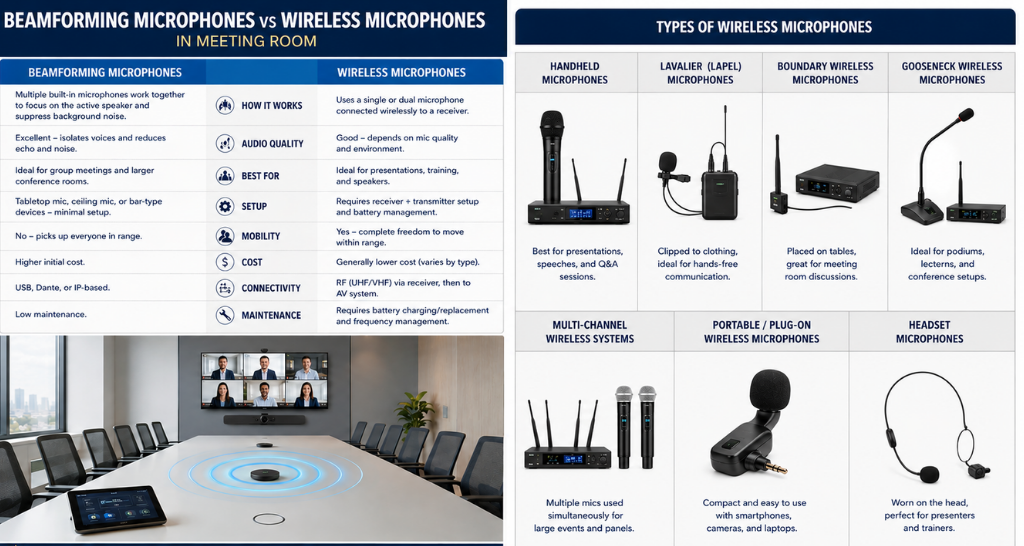
Beamforming vs Wireless Microphones: Which Is Better for Meeting Rooms?
Clear communication is one of the most important factors for successful business collaboration. In today’s hybrid work environment, organizations depend on advanced audio technology to ensure that every participant can hear and be heard clearly during discussions, presentations, and virtual meetings.
A poor-quality microphone setup can create problems such as background noise, unclear voices, audio delays, and difficulty understanding remote participants. This directly affects productivity and collaboration, especially in professional Meeting Rooms where important decisions and discussions take place.
When designing a modern workspace, businesses often compare Beamforming Microphones for Meeting Rooms and Wireless Microphones for Meeting Rooms to determine which solution provides better flexibility, audio quality, and user experience.
Both technologies offer unique advantages. Beamforming microphones focus on intelligent voice capture, while wireless microphones provide mobility and convenience. The right choice depends on factors such as room size, meeting requirements, number of users, and the overall AV setup.
Beamforming Microphones vs Wireless Microphones: Understanding Both Technologies
| Feature | Beamforming Microphones | Wireless Microphones |
| Working Technology | Uses multiple microphone elements in an array to detect the speaker’s voice direction. | Uses a transmitter and receiver to transmit audio wirelessly without cables. |
| Voice Pickup | Automatically focuses on active speakers and captures voices across the room. | Captures the voice of the person wearing or holding the microphone. |
| Background Noise | Reduces unwanted ambient noise through beamforming and DSP processing. | Depends on microphone quality and audio processing; generally picks up the user’s voice directly. |
| User Mobility | No wearable device required; users can speak naturally from their seats. | Offers complete freedom of movement for presenters, trainers, or speakers. |
| Installation | Installed on the ceiling or table as a permanent meeting room solution. | Requires wireless transmitters, receivers, and battery-powered microphones. |
| Best For | Collaborative Meeting Rooms, boardrooms, hybrid meetings, and conference spaces. | Presentations, training sessions, auditoriums, seminars, and stage events. |
| Number of Speakers | Supports multiple participants speaking from different locations. | Primarily designed for one speaker per microphone. |
| Hands-Free Operation | Yes, completely hands-free. | No, users must wear or hold the microphone. |
| Primary Advantage | Delivers clear audio for group discussions without individual microphones. | Provides mobility and flexibility for individual presenters. |
Beamforming microphones and wireless microphones are designed to improve communication, but they work differently.
Beamforming microphones use multiple microphone elements arranged in an array to detect sound direction and focus on the speaker’s voice. Advanced processing technology helps reduce unwanted background sounds and improves voice clarity without requiring users to stay close to a microphone.
On the other hand, Wireless Microphones use a transmitter and receiver system that allows users to speak freely without being connected through physical cables. These microphones are commonly used where presenters, trainers, or speakers need movement flexibility.
Both solutions are widely used in professional Meeting Rooms and Huddle Room AV Solutions, but each serves different communication needs and applications.
Beamforming technology is ideal for spaces where multiple participants need to communicate naturally, while wireless microphones are suitable when individual speakers require mobility.
How Beamforming and Wireless Microphones Work in Meeting Rooms ?
The working mechanism of both microphone technologies plays an important role in deciding which solution fits a specific environment.
Beamforming Microphones
Beamforming microphones use multiple built-in microphone capsules to capture sound from different directions. The system analyzes audio signals and identifies the speaker’s location before enhancing the voice output.
For example, during a conference discussion, participants can speak naturally from different areas of the room without passing a microphone around. The system automatically focuses on active speakers and reduces unwanted ambient noise.
This makes beamforming microphones highly effective for collaborative Meeting Rooms where several people participate in conversations.
Wireless Microphones
Wireless microphones operate through radio frequency or digital wireless transmission. A speaker can carry or hold the microphone and move around the room while maintaining clear audio communication.
They are commonly used in training sessions, presentations, board discussions, and events where a single speaker needs freedom of movement.
Compared with traditional wired microphones, Wireless Microphones for Meeting Rooms offer easier installation and greater flexibility while integrating smoothly with LED Video Wall solutions used in modern meeting spaces.
Audio Quality Comparison: Which Provides Better Voice Clarity?
Audio performance is one of the biggest considerations when selecting Meeting Room Audio Solutions.
Beamforming microphones generally provide better hands-free communication because they are designed to capture voices from multiple participants. They can identify the direction of sound and reduce unwanted noise using digital signal processing.
This makes them suitable for video conferencing environments and modern Meeting Room Solutions, where participants can interact naturally without adjusting microphone positions.
Wireless microphones, however, provide excellent audio clarity when used correctly because the microphone is positioned close to the speaker’s mouth. Since the user directly speaks into the microphone, voice pickup is usually strong and consistent.
The choice depends on the meeting style:
- For group discussions and hybrid collaboration, beamforming technology offers better convenience.
- For presentations and individual speakers, wireless microphones provide better control.
Many advanced Meeting Rooms combine both technologies to achieve maximum flexibility.
Installation and Maintenance Comparison :
When selecting microphone technology, installation requirements and long-term maintenance are important considerations for businesses.
Beamforming Microphones for Meeting Rooms usually require professional installation because they need proper placement, configuration, and integration with other AV equipment. These microphones are often connected with digital signal processors, speakers, cameras, and video conferencing systems to create a complete communication solution.
Once installed correctly, beamforming microphones require minimal user interaction. Their automated voice tracking and noise management features help reduce operational issues and provide a consistent experience during daily meetings.
Wireless microphones are generally easier to deploy because they do not require extensive cabling. Users can quickly connect the microphone system and start presentations or discussions. However, wireless solutions require regular battery management, frequency coordination, and device charging to ensure uninterrupted performance.
For organizations planning long-term technology solutions, professional AV Integration for Meeting Rooms helps ensure that both microphone types are installed, configured, and managed properly.
Which Solution Works Better for Different Meeting Room Sizes?
The ideal microphone choice depends on the purpose, seating arrangement, and number of participants in a space.
Small Meeting Rooms
Small collaboration spaces usually require simple and convenient audio solutions. Beamforming microphones work effectively because participants can sit around a table and communicate naturally without adjusting microphones.
Wireless microphones can also be useful when the room is used for presentations or training sessions where one person needs to speak while moving around.
Conference Rooms
Large conference spaces often include multiple participants, remote attendees, and frequent discussions. In these environments, beamforming technology provides an advantage because it captures voices from different areas of the room.
With advanced Meeting Room Audio Solutions, beamforming microphones can work together with cameras and speakers to create a seamless hybrid meeting experience.
Wireless microphones can be added when executives, presenters, or guest speakers require additional mobility.
Boardrooms
Boardrooms require professional communication quality because they are used for important discussions and decision-making.
Beamforming microphones are commonly preferred because they maintain a clean and organized table setup while allowing multiple participants to speak naturally.
However, wireless microphones can complement the setup during presentations where specific speakers need dedicated audio control.
Training Rooms and Multipurpose Spaces
Training rooms often require flexibility because users may conduct workshops, presentations, and interactive sessions.
Wireless microphones provide excellent mobility for trainers and presenters, while beamforming microphones support participant discussions and audience interaction.
A combination of both technologies can create a versatile environment for different types of sessions.
Role of AV Integration for Meeting Rooms in Microphone Selection
Choosing the right microphone is only one part of creating an effective communication environment. Proper AV Integration for Meeting Rooms ensures that microphones work smoothly with the entire technology ecosystem.
A professional AV setup connects microphones with:
- Video conferencing platforms
- PTZ cameras
- Displays and LED video walls
- Speakers
- Digital signal processors
- Room control systems
For example, when a beamforming microphone detects a speaker, an integrated camera system can automatically focus on that person. Similarly, wireless microphones can provide clear audio during presentations while connected with room speakers and conferencing systems.
Without proper integration, even advanced microphone technology may not deliver the expected performance.
How to Choose Between Beamforming and Wireless Microphones?
The right choice depends on your meeting requirements.
Choose Beamforming Microphones for Meeting Rooms when:
- Multiple people participate in discussions
- Hands-free communication is required
- Hybrid meetings are frequent
- Clean table design is important
- Automatic voice tracking is needed
Choose Wireless Microphones for Meeting Rooms when:
- Presenters need movement freedom
- Training sessions are common
- Individual speakers require dedicated microphones
- Flexible room usage is required
For organizations with diverse meeting requirements, a combination of both technologies often provides the best results.
How Vallect Helps Design Advanced Meeting Room Audio Solutions
Every organization has different communication requirements, room layouts, and collaboration needs. Vallect designs customized Meeting Room Audio Solutions by analyzing space requirements, user behavior, and technology objectives.
Through professional AV Integration for Meeting Rooms, Vallect helps businesses implement complete communication environments that include advanced microphones, video conferencing systems, displays, speakers, and control solutions.
From small collaboration spaces to large corporate boardrooms, the right combination of beamforming and wireless microphone technologies can improve communication quality, user experience, and meeting efficiency.