
 admin
June 2, 2026
admin
June 2, 2026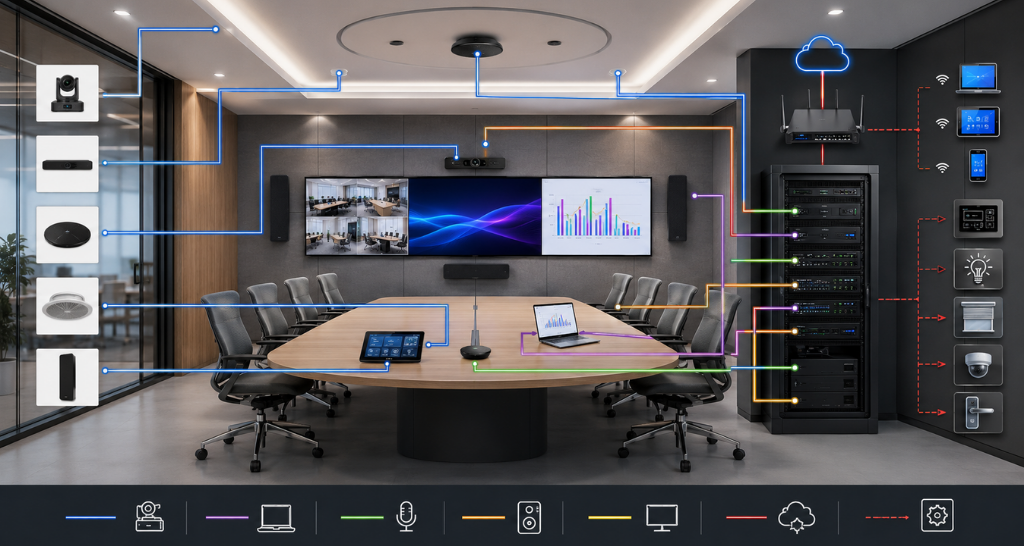
Designing High-Performance Corporate Meeting Rooms with Seamless AV Integration
Workplaces have changed dramatically. Meetings are no longer limited to employees sitting around a conference table in the same office. Today, organizations operate across multiple locations, remote teams collaborate daily, and decision-makers expect technology to work instantly without interruptions. As a result, meeting room design is no longer just about furniture, displays, and room aesthetics. It is about creating an environment where communication, collaboration, and productivity can thrive.
This is where AV Integration plays a critical role. A well-designed meeting room combines audio, video, networking, control systems, and collaboration tools into a unified ecosystem that supports seamless communication. Whether it is a boardroom, conference room, training space, or executive meeting area, effective AV Integration ensures every participant can hear clearly, see presentations without issues, and collaborate without technical disruptions.
Organizations investing in modern workplaces are increasingly prioritizing enterprise meeting room solutions that support hybrid work, future scalability, and a better user experience. The goal is not simply to install technology but to design a meeting environment that helps teams work more efficiently and make faster decisions.
Importance of Seamless AV Integration in Corporate Meeting Rooms
Many businesses still operate meeting rooms that were designed years ago when in-person meetings were the standard. These spaces often struggle to support modern communication needs because the technology infrastructure was never built for hybrid collaboration.
Common challenges include:
- Poor audio quality during virtual meetings
- Limited camera coverage
- Complex cable management
- Difficulty connecting personal devices
- Inconsistent user experience across meeting rooms
- Lack of integration between different communication platforms
These issues create frustration, waste valuable meeting time, and reduce overall productivity.
Modern organizations require meeting rooms that can support both in-person and remote participants equally. This is only possible through strategic AV Integration that aligns technology with workplace requirements.
Rather than treating technology as an afterthought, businesses must incorporate AV Integration into the meeting room design process from the very beginning.
What Should Be Considered Before Designing a Corporate Meeting Room?
Creating a high-performance meeting room starts with understanding how the space will be used. Every organization has unique requirements, and successful room design begins with careful planning.
Room Size and Capacity
The number of participants directly influences display selection, audio coverage, microphone placement, and camera positioning. Larger rooms require more advanced AV Integration strategies to ensure every participant has an equal experience.
Meeting Types
Different meeting spaces serve different purposes:
- Boardroom meetings
- Client presentations
- Training sessions
- Hybrid collaboration
- Executive discussions
Understanding these use cases helps determine the right technology requirements.
Acoustics
Even the most advanced video system cannot compensate for poor audio. Room acoustics should be evaluated during the design phase to minimize echo, background noise, and sound reflections.
Lighting Conditions
Lighting affects camera performance, participant visibility, and presentation quality. Proper lighting design is a critical component of successful AV Integration and High-resolution LED Video Walls deliver stunning visuals, vibrant colors, and seamless display performance. Ideal for events, retail stores, corporate spaces, and advertising.
Future Scalability
Businesses evolve over time. Meeting rooms should be designed with future expansion in mind, allowing organizations to add new technologies without major infrastructure changes.
By considering these factors early, organizations can build meeting spaces that support both current and future business needs.
Key AV Technologies Powering High-Performance Meeting Spaces
A successful meeting room depends on selecting the right technologies and ensuring they work together as a complete ecosystem.
AV-over-IP Infrastructure
AV-over-IP has become one of the most important developments in modern AV Integration.
Instead of relying on traditional point-to-point cabling, AV-over-IP uses standard network infrastructure to distribute audio and video signals.
Benefits include:
- Greater scalability
- Simplified cabling
- Centralized management
- Easier upgrades
- Improved flexibility
AV-over-IP provides the foundation for many modern enterprise meeting room solutions.
Professional Display Systems
Displays are the visual centerpiece of any meeting room.
Depending on room size and requirements, organizations may choose:
- Large-format displays
- Interactive touchscreens
- Video walls
- Direct-view LED displays
The display solution should provide clear visibility for both in-room and remote participants.
Intelligent Camera Systems
Modern meeting rooms require cameras that do more than simply capture video.
Advanced systems now include:
- Auto-framing technology
- Speaker tracking
- AI-powered participant recognition
- Wide-angle coverage
These features enhance corporate meeting room AV integration by creating a more engaging experience for remote attendees.
Digital Signal Processing (DSP)
DSP technology improves audio quality by automatically managing sound levels and reducing unwanted noise.
DSP systems help:
- Eliminate echo
- Reduce background noise
- Improve speech clarity
- Balance audio levels
This technology is a key component of successful AV Integration.
Ceiling and Table Microphones
Clear communication depends on effective microphone coverage.
Modern meeting rooms often use:
- Ceiling microphone arrays
- Beamforming microphones
- Table microphones
- Wireless microphone systems
These solutions ensure every participant can be heard clearly.
Wireless Presentation Systems
Wireless content sharing simplifies collaboration by allowing users to present directly from laptops, tablets, and smartphones.
Benefits include:
- Faster meeting starts
- Reduced cable clutter
- Improved user experience
- Greater flexibility
Wireless sharing solutions have become essential within modern enterprise meeting room solutions.
Room Control and Automation
Automation simplifies meeting room operation.
Users can control:
- Displays
- Cameras
- Audio systems
- Lighting
- Window shades
through a single interface.
This level of AV Integration improves usability and reduces technology-related disruptions.
Common Design Mistakes Reduce Meeting Room Performance:
Even with advanced technology, poor planning can negatively impact results.
Common mistakes include:
- Ignoring Acoustics
- Choosing Technology Based Only on Cost
- Lack of Scalability
- Inadequate Network Infrastructure
- Poor Camera Placement
Role of AV Integration in Enhancing Collaboration and Communication
Many companies make the mistake of designing a room first and adding technology later. This approach often leads to poor performance and unnecessary costs.
A more effective strategy is to incorporate AV Integration during the planning stage.
When technology is integrated into the design process from day one, organizations can optimize:
- Display placement
- Camera positioning
- Speaker coverage
- Microphone locations
- Network infrastructure
- Control systems
- Power management
This ensures every technology component works together seamlessly.
Modern AV Integration focuses on creating a unified experience where users can start meetings, share content, and collaborate without needing technical assistance.
By embedding AV Integration into the room design process, businesses create more efficient and reliable collaboration spaces.
Impact of Integrated AV Systems on Meeting Room Efficiency
Technology requirements continue to evolve as businesses adopt new communication methods and workplace models.
Scalable enterprise meeting room solutions allow organizations to adapt without replacing their entire infrastructure.
Key advantages include:
- Easier expansion
- Support for new collaboration tools
- Simplified upgrades
- Reduced long-term costs
- Better technology lifecycle management
By investing in scalable enterprise meeting room solutions, organizations create a foundation that can support growth for years to come.
Additionally, scalable enterprise meeting room solutions help businesses maintain consistency across multiple office locations while reducing operational complexity.
The Core Backbone of Modern Meeting Room Infrastructure
Meeting room technology has become increasingly sophisticated. Successful implementation requires expertise across multiple disciplines, including networking, audio engineering, video systems, automation, and workplace design.
Professional AV Integration ensures that all technologies work together as a unified system rather than as isolated components.
Benefits include:
- Customized system design
- Reliable implementation
- Better performance optimization
- Ongoing support and maintenance
- Future-ready infrastructure
Organizations that prioritize professional AV Integration typically achieve higher system reliability and stronger return on investment.
Furthermore, professional corporate meeting room AV integration ensures that technology aligns with business goals rather than simply adding more equipment to a room.
How Can Vallect AV Integration Strategy Deliver Long-Term ROI?
The value of AV Integration extends far beyond technology itself. When designed correctly, it directly contributes to business performance.
Organizations benefit from:
- Reduced meeting disruptions
- Faster decision-making
- Improved employee experience
- Enhanced client presentations
- Greater operational efficiency
- Better utilization of office space
As hybrid work continues to evolve, the importance of corporate meeting room AV integration will only increase.
Businesses that invest in strategic AV Integration today position themselves for greater flexibility, improved collaboration, and long-term workplace success.
High-performance meeting rooms are no longer a luxury they are a critical business asset. By combining thoughtful design, advanced technology, and scalable enterprise meeting room solutions, organizations can create collaboration spaces that support productivity, innovation, and growth for years to come.