
 admin
July 20, 2026
admin
July 20, 2026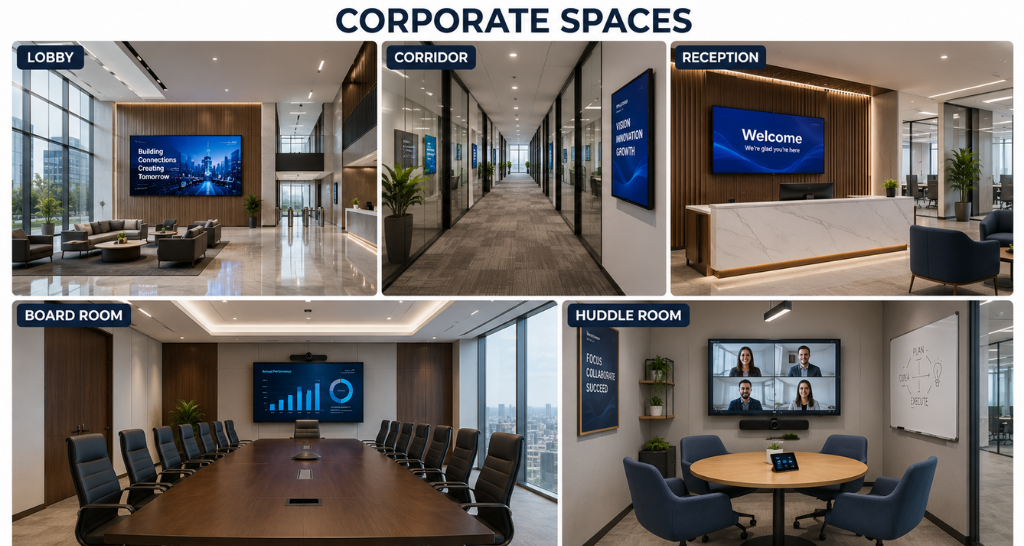
Beyond Screens & Speakers: How AV Integration Transform Corporate Spaces?
Corporate spaces have changed significantly in recent years. A meeting room is no longer simply a room with a table, a display, and a few speakers. Modern workplaces need connected environments that support hybrid meetings, presentations, collaboration, training, communication, and daily business operations.
This is where AV Integration plays an important role. Instead of operating audio, video, conferencing, control, and display technologies as separate systems, AV Integration connects them into one coordinated environment. The result is a workplace where technology becomes easier to use, more reliable, and better aligned with business requirements.
From executive boardrooms to large corporate offices, well-planned Corporate AV Solutions can transform how employees collaborate and how businesses communicate with clients, partners, and remote teams.
However, the value of AV Integration goes beyond simply installing advanced equipment. The real objective is to create a seamless experience where displays, cameras, microphones, speakers, control systems, and networks work together efficiently.
What is AV Integration?
AV Integration is the process of designing, connecting, configuring, and managing multiple audio-visual technologies as one unified system.
A typical corporate environment may include:
- Video conferencing systems
- Professional microphones
- Speakers
- Displays
- LED video walls
- Projectors
- Audio DSPs
- Control systems
- Wireless presentation systems
- Digital signage
- Network infrastructure
Without proper AV Integration, these systems may operate independently, creating a complicated user experience. With professional integration, users can control multiple devices through a simplified interface.
For example, entering a meeting room may automatically activate the display, camera, microphone, and conferencing platform. This is the practical value of AV Integration in Corporate spaces.
Professional Audio Visual Solution for Corporate Offices are designed around the specific requirements of the space, including room size, seating capacity, acoustics, lighting, network infrastructure, and business objectives.
Why is AV Integration Important for Corporate Spaces?
Businesses today depend on technology for communication and collaboration. However, simply adding more devices does not always improve productivity. If systems are difficult to operate or incompatible with each other, technology can create more problems than solutions.
Professional AV Integration addresses these challenges by creating a connected and user-friendly technology environment.
1. Simplifies Technology Usage
Employees should not need technical expertise to start a meeting or share a presentation. Integrated controls simplify daily operations.
2. Supports Hybrid Collaboration
Modern AV Systems for Workspaces connect in-office and remote participants through high-quality video and audio.
3. Improves Meeting Efficiency
Automated systems reduce the time spent connecting devices, adjusting settings, and troubleshooting technical issues.
4. Enhances Communication Quality
Clear audio and high-resolution visuals improve the quality of internal meetings, client presentations, and training sessions.
5. Creates Scalable Workspaces
Businesses can expand their technology infrastructure as their requirements grow.
How Does AV Integration Work?
The AV Integration process combines different technologies into a structured workflow.
Step 1: Requirement Analysis
The first step is understanding how the corporate space will be used.
Questions include:
- How many people will use the room?
- Will remote participants join meetings?
- What content needs to be displayed?
- Does the room require recording or streaming?
- How much automation is required?
Step 2: Site Survey
A professional site survey evaluates:
- Room dimensions
- Seating arrangement
- Lighting conditions
- Acoustics
- Power availability
- Network infrastructure
- Cable pathways
This information helps create an effective system design.
Step 3: System Design
The integration team designs the complete technology architecture. This includes selecting displays, microphones, speakers, cameras, processors, control systems, and network equipment.
The objective is to ensure that all components work together efficiently.
Step 4: Installation
Equipment is installed according to the approved design. Proper cable management, equipment placement, mounting, and safety standards are essential.
Step 5: Configuration and Programming
The devices are connected and configured to communicate with each other. Control panels may be programmed to operate multiple functions from one interface.
Step 6: Testing and Commissioning
The complete system is tested for:
- Audio clarity
- Video quality
- Signal stability
- Device compatibility
- Control functionality
- Network performance
This ensures the final Corporate AV Solutions setup performs reliably.
Non-Integrated Corporate Space vs Integrated AV Workspace :
| Feature : | Non-Integrated Corporate Space | Integrated AV Workspace |
| Device Control | Manual | Centralized |
| Meeting Setup | Time-consuming | Faster and simplified |
| Collaboration | Limited | Hybrid-ready |
| Audio Quality | Basic | Professionally optimized |
| Display Options | Limited | Scalable and flexible |
| Troubleshooting | Frequent | Reduced through integration |
| Future Expansion | Difficult | Easier to scale |
A well-designed AV Integration strategy ensures that technology supports the way employees actually work instead of creating additional complexity.
The Role of AV Integration in Smart Workspaces :
The modern workplace includes multiple types of spaces, each with different technology requirements. A boardroom may need executive conferencing and centralized control, while a training room may require content sharing and interactive displays.
Similarly, a large corporate office may need digital signage, collaboration rooms, and centralized monitoring.
This is why Audio Visual Solutions for Corporate Offices must be designed according to the purpose of each space rather than using the same system everywhere.
When implemented correctly, AV Integration transforms technology from a collection of individual devices into a connected workplace infrastructure.
Key Components and Technologies of AV Integration :
The effectiveness of AV Integration depends on how well different technologies communicate and operate together. A corporate space may use several devices from different manufacturers, making professional system design and configuration essential.
1. Displays and LED Video Walls
Displays are central to corporate communication. Meeting rooms may use commercial displays, projectors, or large-format LED solutions depending on the room size and viewing distance.
For larger corporate environments, an Indoor LED Display can provide high-visibility visuals for presentations, dashboards, internal communication, and collaboration.
Outdoor corporate campuses may also require an Outdoor LED Display for digital signage, announcements, branding, or visitor communication.
2. Video Conferencing Systems
Cameras, microphones, speakers, and conferencing platforms work together to connect remote participants with in-room attendees.
Advanced systems may include:
- AI-powered cameras
- Speaker tracking
- Auto framing
- Noise cancellation
- Echo cancellation
- Beamforming microphones
3. Audio Systems and DSP
Professional audio systems improve speech clarity and listening comfort. Digital Signal Processors help manage audio signals, reduce echo, and balance sound levels.
4. Control Systems
Centralized control panels allow users to manage displays, lighting, audio, video sources, and conferencing systems from a single interface.
5. Wireless Presentation Systems
Wireless content sharing allows users to present from laptops and mobile devices without complicated cable connections.
6. Network Infrastructure
Modern AV Systems for Workspaces increasingly depend on IP networks for signal distribution, device communication, monitoring, and centralized management.
Benefits of AV Integration for Corporate Spaces
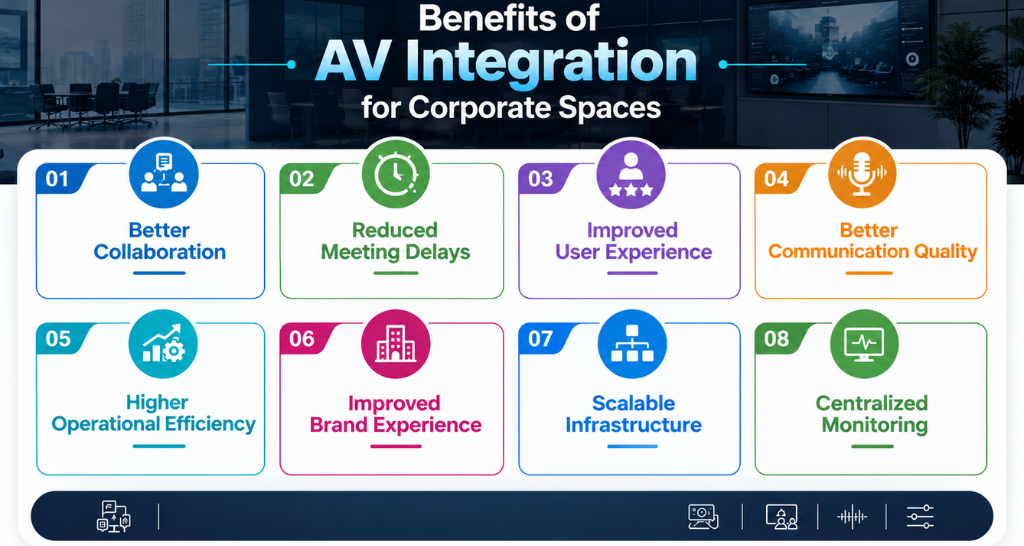
1. Better Collaboration
Integrated systems help employees collaborate across offices, cities, and countries.
2. Reduced Meeting Delays
Simplified controls and automated workflows reduce the time spent preparing meeting rooms.
3. Improved User Experience
Employees can operate complex technology through intuitive interfaces.
4. Better Communication Quality
Professional audio and video systems improve clarity during meetings and presentations.
5. Higher Operational Efficiency
Connected systems reduce manual processes and make technology easier to manage.
6. Improved Brand Experience
A well-designed corporate technology environment creates a more professional impression for clients and visitors.
7. Scalable Infrastructure
Businesses can add new rooms, displays, and technologies without redesigning the entire system.
8. Centralized Monitoring
Organizations can monitor connected devices and identify potential issues more efficiently.
What Happens If a Corporate Space Does Not Upgrade?
Many organizations continue using separate, outdated technologies because existing equipment still functions. However, this can create long-term challenges.
Frequent Technical Problems
Disconnected systems may result in compatibility issues, signal failures, and meeting delays.
Poor User Adoption
If systems are difficult to operate, employees may avoid using advanced features.
Limited Collaboration
Older systems may not support modern hybrid work requirements.
Higher Downtime
Without proactive monitoring and support, small technical issues can become major failures.
Difficult Expansion
Legacy systems may not support new technologies or future workplace requirements.
A professional Corporate AV Integration strategy helps businesses move from reactive technology management to a more structured and scalable approach.
Facts and Figures :
The growing adoption of hybrid work has increased the need for reliable workplace technology.
- Modern corporate meeting spaces increasingly support both in room and remote participants.
- High-resolution displays improve the visibility of presentations, dashboards, and shared content.
- IP-based AV systems allow devices to communicate over existing network infrastructure.
- Centralized control can reduce the number of manual steps required to operate meeting room equipment.
- Preventive maintenance helps identify potential issues before they cause significant downtime.
These trends demonstrate why businesses are investing in integrated Corporate AV Solutions rather than isolated devices.
How Vallect Helps with AV Integration ?
Vallect provides end-to-end AV Integration services for corporate offices, boardrooms, conference rooms, training spaces, auditoriums, and other professional environments.
Our process begins with understanding the business requirement and continues through design, installation, integration, testing, and support.
Our Services Include
- Requirement analysis
- Site surveys
- AV system design
- Equipment selection
- Installation
- System programming
- Testing and commissioning
- User training
- Preventive maintenance
- Technical support
As experienced AV System Integrators, Vallect focuses on creating solutions that are reliable, scalable, and simple to use.
For organizations operating in the National Capital Region, professional Audio Visual Integrators in delhi can help ensure that local site conditions, infrastructure, and deployment requirements are properly considered.
Our expertise can also extend to integrated technology environments that require coordination with ELV System Integrators, ensuring AV systems work effectively with broader building and security infrastructure.
For organizations that need ongoing technical assistance, AV Maintenance & Support helps maintain system performance, reduce downtime, and improve the lifespan of installed equipment.