
 admin
July 20, 2026
admin
July 20, 2026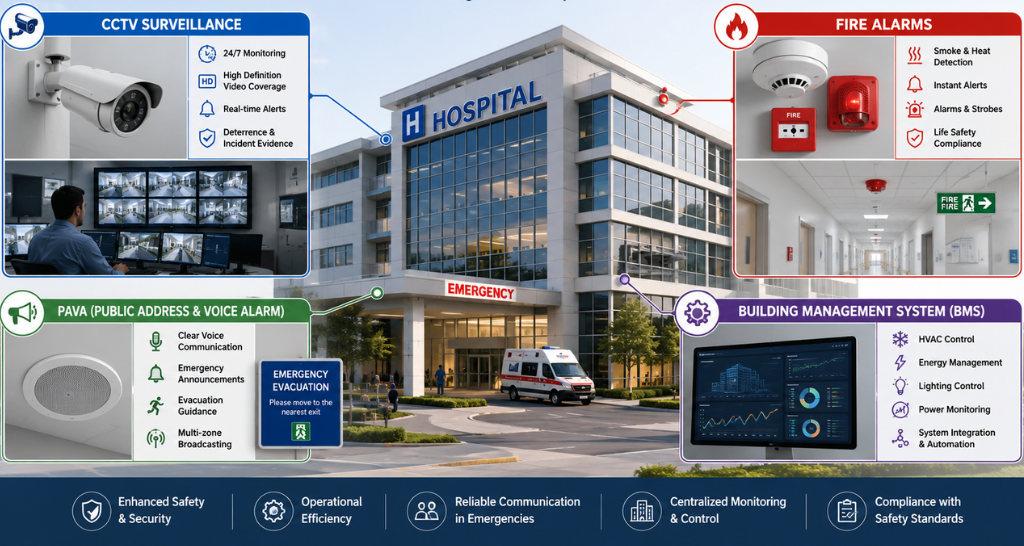
CCTV to Access Control: How ELV Systems Transform Hospital Security?
Hospitals are complex environments that operate around the clock. Patients, doctors, nurses, visitors, emergency teams, contractors, and support staff move through different areas every day. At the same time, hospitals manage sensitive patient information, expensive medical equipment, pharmaceuticals, restricted areas, and critical infrastructure.
This makes security a major operational requirement. A single CCTV camera is no longer enough to protect a modern healthcare facility. Hospitals need connected systems that can monitor activity, control access, detect threats, and help security teams respond quickly.
This is where ELV Systems play an important role. By integrating surveillance, access control, intrusion detection, communication, networking, and monitoring technologies, ELV Systems create a more coordinated security environment.
Modern Hospital Security Systems are moving from isolated devices to integrated platforms. Instead of monitoring CCTV separately from access control or alarm systems, security teams can manage multiple technologies through a centralized infrastructure.
For healthcare organizations planning to modernize their security infrastructure, ELV Systems for Hospitals offer a scalable approach that improves visibility, operational control, and response capabilities.
What Are ELV Systems?
ELV Systems refer to Extra Low Voltage systems that use low-voltage infrastructure to support communication, security, monitoring, automation, and information technology functions within a facility.
In a hospital environment, these systems can include:
- CCTV surveillance
- Access control
- Video management systems
- Intrusion detection
- Intercom systems
- Public address systems
- Nurse call systems
- Structured cabling
- Network infrastructure
- Fire alarm integration
- Building management integration
The main advantage of ELV Systems is that different technologies can work together instead of operating as completely separate solutions.
For example, when an unauthorized person attempts to enter a restricted medical area, the access control system can generate an alert. The associated CCTV camera can automatically display the relevant video feed to the security team. This creates a faster and more informed response.
This integrated approach forms the foundation of modern Healthcare Security Solutions.
Why It is Important for Hospitals?
Hospitals have unique security requirements compared with conventional commercial buildings. Security teams must protect the facility while ensuring that patients, staff, and authorized visitors can move efficiently through the building.
1. Hospitals Operate 24/7
Healthcare facilities cannot simply shut down for security checks or maintenance. Emergency departments, intensive care units, pharmacies, laboratories, and critical infrastructure operate continuously.
ELV Systems support continuous monitoring and help security teams identify incidents at any time of the day or night.
2. Multiple Security Zones
A hospital may include public areas, staff-only zones, laboratories, pharmacies, operating rooms, server rooms, and emergency areas.
Each area may require different access permissions. Integrated Hospital Security Systems help organizations define and manage these access levels more effectively.
3. Sensitive Assets and Information
Hospitals contain expensive medical equipment, medicines, confidential patient information, and critical digital infrastructure.
A combination of surveillance and access control helps improve protection across these different asset categories.
4. Large and Complex Facilities
Large hospitals may have multiple buildings, entrances, parking areas, service corridors, and emergency access points.
A centralized security infrastructure helps security personnel monitor these locations from a unified environment.
What Happens If Hospitals Don’t Upgrade?
Many healthcare facilities still depend on disconnected cameras, manual access control, and outdated monitoring systems. While these systems may continue to function, they can create serious operational limitations.
Security Blind Spots
Older Hospital Surveillance Systems may not provide adequate coverage across expanding hospital campuses.
Delayed Incident Response
If CCTV and access control operate independently, security teams may need to manually identify the location of an incident before reviewing the relevant camera feed.
Unauthorized Access
Without intelligent access management, restricted areas may be difficult to monitor effectively.
Higher Operational Costs
Legacy systems may require separate maintenance, monitoring, and support arrangements.
Limited Scalability
Adding new cameras or access points to outdated infrastructure can become complicated and expensive.
Fragmented Information
When security information is distributed across multiple platforms, operators may not have a complete picture of what is happening during an incident.
Upgrading to integrated ELV System Integrators in Delhi helps hospitals overcome these challenges by connecting security technologies into a more coordinated infrastructure.
How Do ELV Systems Work in Hospital Security?
The effectiveness of ELV Systems comes from the way different technologies communicate and share information.
Step 1: Data Collection
Security devices collect information from different areas of the hospital.
This may include:
- CCTV cameras
- Card readers
- Biometric devices
- Door sensors
- Motion detectors
- Emergency buttons
Step 2: Network Communication
The collected information travels through the hospital’s structured network infrastructure.
A reliable network allows security devices to communicate with centralized servers and monitoring systems.
Step 3: Data Processing
Video management software and access control platforms process incoming information.
For example, the system may identify:
- An unauthorized access attempt
- A door held open for too long
- Movement in a restricted area
- Suspicious activity near a sensitive location
Step 4: Centralized Monitoring
Security teams can view alerts, camera feeds, and access events through a centralized monitoring platform.
This makes Healthcare Security Solutions more efficient than disconnected security devices.
Step 5: Response and Documentation
Once an event is detected, security personnel can investigate the incident, review video footage, verify access records, and take appropriate action.
Non-Integrated Hospital Security vs Integrated ELV Security:
| Feature | Traditional Security Setup | Integrated ELV Systems |
|---|---|---|
| CCTV | Standalone monitoring | Integrated with other systems |
| Access Control | Separate operation | Connected with surveillance |
| Incident Response | Manual investigation | Faster alert-based response |
| Monitoring | Multiple platforms | Centralized monitoring |
| Scalability | Limited | Flexible and expandable |
| Data | Fragmented | Connected and accessible |
| Maintenance | Reactive | Can support preventive monitoring |
The transition from standalone CCTV to integrated ELV Systems allows hospitals to move toward a more intelligent, connected, and scalable security infrastructure.
Key Components and Technologies of ELV Systems:
The effectiveness of ELV Systems depends on the integration of multiple technologies. Each component performs a specific function, but together they create a unified security infrastructure for healthcare facilities.
1. CCTV Surveillance Systems
CCTV cameras provide continuous visual monitoring across hospital premises. Modern IP cameras can offer high-resolution imaging, low-light performance, wide-angle coverage, and intelligent analytics.
They can be installed in:
- Entrances and exits
- Parking areas
- Corridors
- Emergency departments
- Pharmacies
- Restricted zones
- Perimeter areas
When integrated with access control, CCTV can help security teams verify who entered a particular area and when.
2. Access Control Systems
Access control restricts entry to sensitive areas based on user permissions.
Hospitals may use:
- RFID cards
- Biometric readers
- PIN-based access
- Mobile credentials
- Smart card systems
These technologies help ensure that only authorized personnel can access locations such as laboratories, operating rooms, pharmacies, and server rooms.
3. Video Management Systems
A Video Management System (VMS) collects and manages camera feeds from different areas.
It enables security teams to:
- View live video
- Search recorded footage
- Manage camera feeds
- Review incidents
- Configure alerts
This is a central part of modern Hospital Surveillance Systems & Outdoor LED Display
4. Intrusion Detection Systems
Intrusion detection systems identify unauthorized movement or entry into restricted zones.
They may use:
- Door sensors
- Motion detectors
- Perimeter sensors
- Glass-break detectors
When an unusual event occurs, the system can send an alert to the security team.
5. Intercom and Emergency Communication
Communication systems help security teams, staff, and visitors communicate during normal operations and emergencies.
These systems can be integrated with broader ELV Systems to improve communication across the facility.
6. Structured Cabling and Network Infrastructure
Security systems depend on reliable network connectivity.
Structured cabling, fiber optic infrastructure, network switches, and secure communication systems help ensure that surveillance and access control devices can operate continuously.
7. Fire and Life Safety Integration
Security infrastructure can be integrated with fire alarm and emergency systems to improve situational awareness during critical events.
This allows security teams to coordinate access, surveillance, and emergency response more effectively.
Benefits of ELV Systems for Hospitals:
1. Improved Security Visibility
Integrated systems allow security personnel to monitor multiple areas through a centralized platform.
2. Faster Incident Response
Real-time alerts help security teams identify potential incidents more quickly.
3. Better Access Management
Hospitals can create different access permissions for doctors, nurses, technicians, contractors, and visitors.
4. Protection of Critical Areas
Sensitive zones such as pharmacies, laboratories, server rooms, and operating areas can receive additional security controls.
5. Centralized Monitoring
A centralized platform simplifies security operations and improves coordination.
6. Scalability
As hospitals expand, new cameras, access points, and monitoring devices can be added to the existing infrastructure.
7. Improved Investigation
Video recordings and access logs help security teams investigate incidents more efficiently.
8. Reduced Operational Complexity
Instead of managing multiple isolated systems, hospitals can manage interconnected technologies through a coordinated infrastructure and Indoor LED Display.
These advantages make ELV Systems for Hospitals a valuable investment for healthcare facilities planning long-term security improvements.
Facts and Figures About Healthcare Security:
Healthcare facilities are increasingly adopting technology-driven security infrastructure because of the complexity of modern hospital operations.
- Hospitals operate continuously, requiring security systems capable of 24/7 monitoring.
- Large healthcare campuses may contain hundreds of surveillance points and multiple restricted access areas.
- IP-based systems provide greater scalability than traditional analog infrastructure.
- Centralized monitoring helps security teams manage multiple systems from a unified environment.
- Digital access records can improve incident investigation and accountability.
- AI-enabled video analytics can support automated detection of unusual activity.
These developments are increasing the demand for integrated Healthcare Security Solutions across hospitals, medical colleges, research centers, and healthcare campuses.
How Vallect Helps Hospitals?
Vallect provides end-to-end ELV Systems solutions for healthcare facilities, corporate campuses, institutions, and large infrastructure projects.
The process begins with understanding the facility’s security requirements, operational zones, existing infrastructure, and future expansion plans.
Vallect’s services include:
- Security requirement analysis
- Site surveys
- System design
- CCTV planning
- Access control integration
- Network infrastructure planning
- Command center integration
- Installation and commissioning
- Testing and documentation
- Preventive maintenance
- Technical support
As experienced AV System Integrators, Vallect can also coordinate security infrastructure with broader technology environments where communication, visualization, and facility systems need to work together.
For organizations looking for specialized AV System Integrators in Delhi, Vallect provides technology planning and integration support for complex commercial and institutional environments.
Healthcare facilities may also require visual communication solutions such as an Indoor LED Display for reception areas, command centers, or information zones.
For outdoor campus areas and large external environments, an Outdoor LED Display can support communication and public information requirements.
After installation, regular AV Maintenance & Support helps maintain system reliability and reduce unexpected downtime.
For organizations seeking specialized ELV System Integrators in Delhi, Vallect can support the complete lifecycle of an integrated security infrastructure, from consultation and design to installation and long-term support.