
 admin
June 9, 2026
admin
June 9, 2026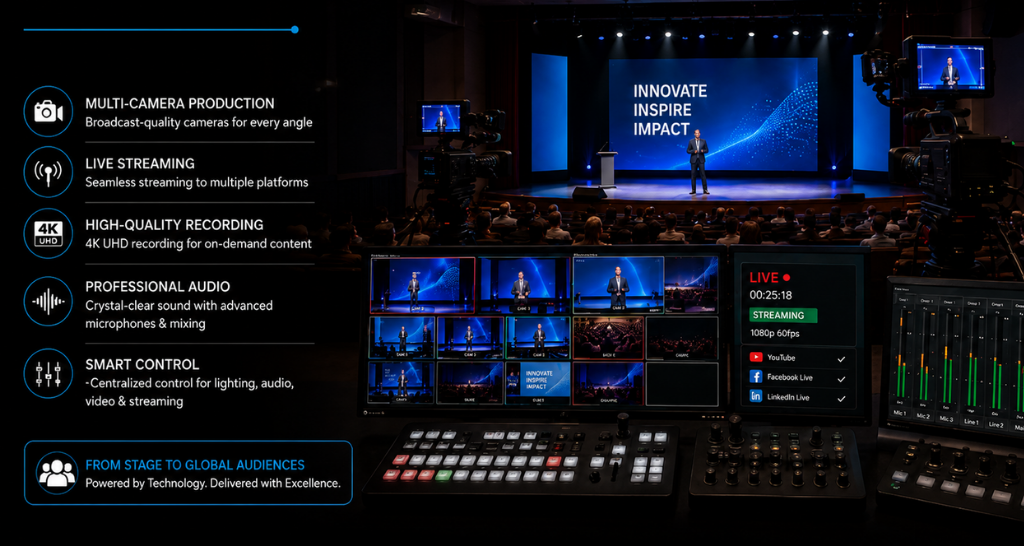
From Stage to Screen: Advanced Recording & Streaming Technology in Auditorium AV
Modern auditoriums are no longer limited to physical audiences. Today, Audio Visual Technologies are transforming traditional performance spaces into hybrid communication hubs where events can be recorded, broadcast, and streamed globally in real time. From educational seminars and corporate conferences to cultural performances and government events, audiences now expect seamless digital access alongside in-person experiences.
This transformation is powered by Auditorium AV and advanced Audio Visual Technologies, which integrate high-definition capture, real-time processing, and low-latency streaming systems. Modern Auditorium AV solutions enable seamless content delivery for both in-person and remote audiences. As demand grows, institutions are increasingly investing in Auditorium Recording and Streaming Technology, while Auditorium AV systems help extend their reach beyond physical boundaries.
In this article, we explore how modern systems are redefining engagement, what components make them possible, and why they are becoming essential for future-ready auditoriums. Auditorium AV solutions integrate advanced audio, video, lighting, control, and streaming technologies to deliver clear communication, immersive presentations, seamless performances, and enhanced audience experiences in modern auditoriums.
What is Auditorium Recording and Streaming Technology?
Auditorium Recording and Streaming Technology refers to the integrated systems used to capture, process, store, and broadcast live events held in auditoriums. These systems allow events to be recorded in high quality and streamed across digital platforms in real time or on-demand.
At its core, this technology combines cameras, microphones, video switchers, encoders, and network streaming platforms. All of these elements are controlled through advanced Audio Visual Technologies, ensuring synchronized audio and video delivery.
Unlike traditional recording setups, modern Auditorium Recording and Streaming Technology supports multi-camera switching, automated tracking, and cloud-based distribution. This makes it possible to deliver professional-grade broadcasts without requiring large production teams.
In essence, Audio Visual Technologies act as the backbone that enables smooth integration between physical events and digital audiences.
Why Auditorium Recording and Streaming Technology important ?
The importance of Auditorium Recording and Streaming Technology has grown significantly due to the rise of hybrid communication models. Institutions can no longer rely solely on physical attendance.
One of the major reasons is global accessibility. With Auditorium Live Streaming Solutions and advanced Auditorium AV systems, events can reach audiences across cities, countries, and time zones instantly. This capability makes Auditorium AV an essential investment for universities, corporate organizations, and government institutions seeking to expand their audience reach and improve communication effectiveness.
Another key factor is engagement. High-quality Audio Visual Technologies enhance clarity, reduce distortion, and ensure that viewers experience the event almost as if they were physically present.
Cost efficiency is also a major advantage. Once installed, Auditorium Recording and Streaming Technology reduces the need for repeated event setups, travel, and external production crews.
Additionally, recorded sessions can be reused for training, marketing, or archival purposes, making Audio Visual Technologies a long-term investment rather than a one-time setup.
Key Impact Metrics: Auditorium Recording & Streaming Technology :
| S.No. | Key Benefit / Parameter | Key Figures & Target Metrics | Practical Impact |
| 1. | Global Accessibility | 100% Remote Reach | Events instantly cross cities, countries, and time zones eliminating physical seating capacity limits. |
| 2. | Audience Engagement | Near-Zero Distortion | High-quality AV tech maximizes viewer retention by simulating a live, in-person room experience. |
| 3. | Operational Cost Efficiency | Significant Setup Reductions | Eliminates repeated event setups, travel overheads, and recurring external production crew costs. |
| 4. | Content Lifecycle & ROI | Infinite Reuse / Lifetime Value | 1 single live session translates into endless archival, training modules, and marketing assets. |
| 5. | Attendance Model Flexibility | 2-Way Hybrid Model | Combines physical attendance with digital streaming to cater to the modern hybrid workforce and student base. |
Applications & Components of Auditorium AV Systems :
Modern audio visual systems for auditoriums are designed to handle a wide range of applications and use cases.
Core Components
- Cameras & Video Capture Systems
High-definition PTZ cameras form the foundation of Auditorium Recording and Streaming Technology, enabling automated tracking of speakers and performers. - Audio Systems
Microphones, mixers, and sound processors ensure crystal-clear sound capture, a crucial aspect of Audio Visual Technologies. - Video Switchers & Control Units
These devices manage multiple input sources, allowing operators to switch between different camera angles in real time. - Encoding & Streaming Devices
These convert raw audio-video signals into digital streams suitable for online platforms, forming the backbone of Auditorium Live Streaming Solutions. - Display Systems
LED walls and projection screens enhance the in-room experience while synchronizing with streamed content.
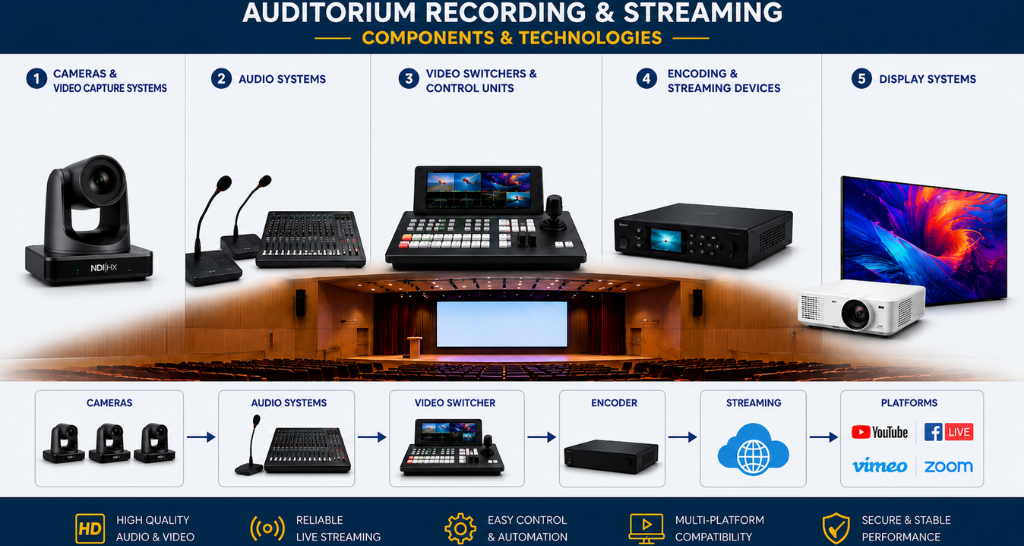
Together, these components form an ecosystem powered by Audio Visual Technologies, ensuring smooth integration between hardware and software systems.
Implementation / Deployment :
Deploying Auditorium Recording and Streaming Technology requires careful planning and system integration.
The first step is site assessment. Engineers evaluate auditorium size, acoustics, lighting conditions, and seating arrangement to design optimized audio visual systems for auditoriums.
Next comes system design and integration. This includes selecting camera positions, microphone placements, and network infrastructure to support Auditorium Live Streaming Solutions and LED Video Wall technology combines multiple LED panels to create a seamless large-format display, delivering high brightness, vivid colors, dynamic content, and immersive visual experiences.
After installation, calibration is critical. Audio balancing, video synchronization, and latency testing ensure smooth operation. At this stage, Audio Visual Technologies play a crucial role in fine-tuning performance.
Training is another important phase. Operators must understand control interfaces, switching systems, and troubleshooting procedures to manage Auditorium Recording and Streaming Technology effectively. Proper training ensures that Auditorium AV systems operate smoothly, while enabling staff to maximize the performance and reliability of Auditorium AV solutions during live events and broadcasts.
Finally, testing and live simulation ensure the system is ready for real-world use. Proper deployment ensures that Audio Visual Technologies deliver consistent performance under live conditions.
Emerging Innovations in Recording & Streaming Technology
The future of Audio Visual Technologies in auditoriums is rapidly evolving with advancements in AI, automation, and cloud computing.
One major trend is AI-based camera tracking. Smart systems can automatically follow speakers without manual intervention, improving Auditorium Recording and Streaming Technology efficiency.
Another trend is cloud-based streaming. Modern Auditorium Live Streaming Solutions are shifting from local servers to cloud platforms, enabling scalable and global distribution.
Augmented reality (AR) and virtual reality (VR) are also expected to enhance audio visual systems for auditoriums, creating immersive hybrid experiences.
Edge computing is another innovation that reduces latency and improves real-time streaming performance, making Audio Visual Technologies more reliable than ever.
Lastly, integration with analytics tools allows institutions to track viewer engagement and optimize future events.
Vallect’s Expertise in Auditorium Recording & Streaming Technology
Vallect delivers end-to-end expertise in advanced Audio Visual Technologies, helping institutions build modern, high-performance auditorium environments. The focus is on designing and integrating complete Auditorium Recording and Streaming Technology solutions that ensure seamless audio clarity, professional-grade video capture, and smooth live broadcasting.
From planning camera layouts and optimizing acoustics to deploying advanced switching and encoding systems, Vallect ensures every component of Auditorium AV systems works in perfect synchronization. These integrated solutions combine audio, video, control, and streaming technologies to create seamless audience experiences while supporting modern hybrid communication requirements. The solutions are designed to enable reliable Auditorium Live Streaming Solutions for educational institutions, corporate conferences, cultural performances, and large-scale public events, ensuring high-quality content delivery both inside the auditorium and to remote audiences worldwide.
Vallect also emphasizes scalability and future readiness, ensuring systems can adapt to evolving Audio Visual Technologies such as cloud streaming, AI automation, and multi-platform broadcasting. With strong focus on installation quality, system integration, and post-deployment support, Vallect helps organizations achieve a stable, future-proof auditorium AV ecosystem.
Explore : Auditorium AV Integration in Jyoti Bishnu Prekhyagriha
The evolution of modern auditoriums is deeply connected to advancements in Audio Visual Technologies. With the rise of hybrid communication, Auditorium Recording and Streaming Technology has become essential for education, business, and public engagement.
From high-quality audio visual systems for auditoriums to scalable Auditorium Live Streaming Solutions, these technologies are reshaping how content is delivered and consumed.
As innovation continues, institutions that invest in advanced Audio Visual Technologies will be better positioned to reach wider audiences, improve engagement, and future-proof their communication infrastructure.