
 admin
May 27, 2026
admin
May 27, 2026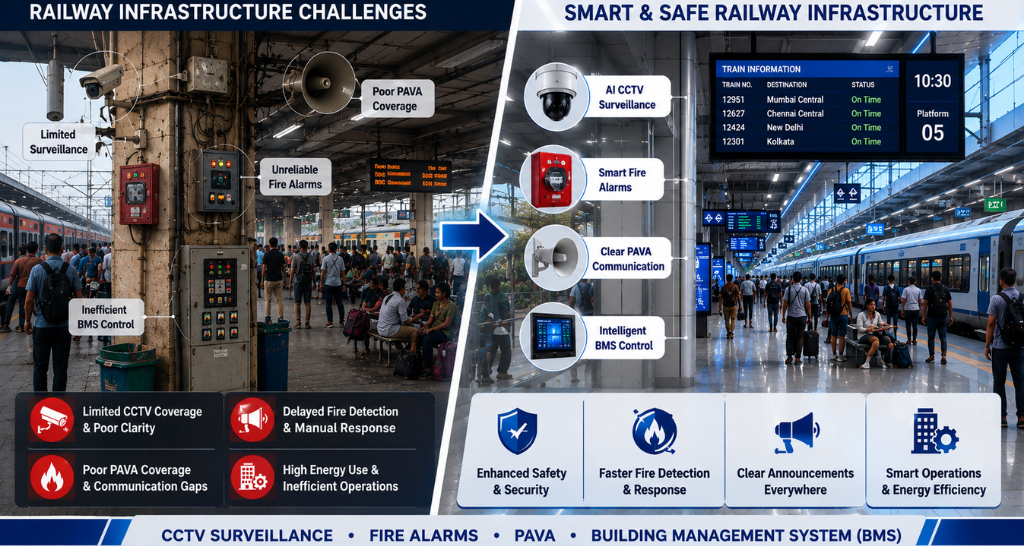
Solving Railway Infrastructure Challenges Through Intelligent ELV Integration
How modern Extra Low Voltage systems are quietly transforming the safety, communication, and intelligence of railway stations across the country.
The Problem Nobody Talks About
Every day, crores of passengers board trains. They trust the platform lights to work, the announcement to be on time, the cameras to be watching, and the doors to stay secure. What they don’t see what nobody talks about is the invisible nervous system underneath all of it.
That nervous system is called ELV Integration.
Extra Low Voltage systems operating below 50V AC or 120V DC are not about powering the station. They are about intelligencing it. CCTV networks, fire alarms, public address systems, access control, passenger information displays, building management systems all of these fall under the umbrella of Railway Extra Low Voltage Solutions. And when they work together? A railway station stops being a passive infrastructure and becomes a living, responsive safety organism.
But when they don’t work together when each system sits in its own silo the results can be slow, inconsistent, and dangerously human-dependent.
This blog is about how Intelligent ELV Integration solves that problem, layer by layer.
Challenge 1: Surveillance Blind Spots and Slow Response
Walk into most older railway stations and you’ll find CCTV cameras lots of them. But scratch beneath the surface and you’ll find a troubling reality: many of these cameras feed into isolated DVR units with no central monitoring, no analytics, and no connection to any other system. An incident happens; someone has to physically retrieve footage three hours later.
Railway Safety and Surveillance Integration fixes this at the root.
When IP-based HD cameras are connected to the core ELV Integration backbone, each camera becomes an intelligent node not just a recorder, but a real-time analytical device. Video analytics software detects crowd density spikes, flags unattended baggage, and triggers motion alerts in restricted zones. The moment a camera detects an anomaly, the integrated system reacts: access control locks relevant doors, control room receives an alert, and the event is logged all within seconds.
This is the difference between a camera that sees and a system that responds.
Modern Smart Railway ELV Systems take this further by linking surveillance to access control through seamless ELV Integration. Any unauthorized entry attempt into a maintenance corridor or restricted zone triggers a multi-system response camera capture, door lock, alert notification simultaneously. No radio call needed. No guard running across the platform. The system handles it.
Challenge 2: Communication Failures During Critical Moments
Imagine a train delay on a foggy morning. The announcement goes out but only two of six platforms hear it clearly. One speaker is too loud, another is distorted from weather damage, and the PA system has no way to address specific zones. Passengers wait, frustrated and uninformed.
This is not a rare scenario. It is a daily reality in stations that haven’t adopted Railway Extra Low Voltage Solutions for their communication layer.
A Distributed Audio System (DAS) a core component of Smart Railway ELV Systems solves this completely. Every speaker zone is individually controlled through a centralized Digital Signal Processor. Normal operations run zone-specific announcements. Emergency situations? The system automatically overrides everything, mutes background audio, and broadcasts to specific zones or the entire station based on the nature of the threat.
The real power comes from integration. When the PA system is bridged with the Fire Alarm System through the ELV Integration framework, smoke detector triggers automatically activate pre-recorded evacuation broadcasts. No staff member needs to run to a microphone. No precious seconds are lost. The announcement happens the moment the sensor fires.
This is Railway Safety and Surveillance Integration working at its best communication that is automatic, zoned, and life-saving.
Challenge 3: Unauthorized Access and Perimeter Weakness
Railway stations are high-footfall, open environments which makes perimeter security genuinely complex. Maintenance corridors, electrical rooms, server rooms, track-side access points these are all vulnerable if access control is handled through old-fashioned lock-and-key.
Intelligent ELV Integration replaces that vulnerability with a layered, intelligent perimeter.
Smart card readers, biometric authentication, electromagnetic locks, and electric strike plates form the physical layer. But the intelligence comes from how Railway Extra Low Voltage Solutions connect these elements to the broader system. Every entry attempt is logged. Every failed authentication generates an alert. Time-bound credentials for contractors and visiting staff ensure nobody has access beyond what they need, for longer than they need it.
When an unauthorized individual attempts entry, the response is not a guard noticing something suspicious it is an automated, near-instantaneous multi-system reaction. Camera captures. Door locks. Alert fires. All in under two seconds.
For station administrators, this means one thing above all: accountability. Every door opened, every credential used, every anomaly flagged all recorded and reviewable through the Smart Railway ELV Systems management dashboard.
Challenge 4: Fire and Life Safety Speed is Everything
In a fire emergency, every second counts. Traditional fire safety setups in many stations involve a detector triggering an alarm and then staff manually responding, making announcements, guiding evacuation, and adjusting ventilation. This chain of human actions takes minutes. In a fire, minutes cost lives. With smart ELV Integration, these emergency systems work together automatically for faster response, coordinated communication, and improved passenger safety.
Smart Railway ELV Systems collapse that response chain into seconds.
An addressable fire alarm system within the ELV Integration framework means each detector has a unique address the control panel knows exactly where the smoke is, not just that smoke exists somewhere. This precision allows zone-specific responses rather than full-station chaos.
More critically, the fire system integrates with HVAC, emergency lighting, PA, and access control simultaneously. The moment a sensor fires:
- Ventilation shifts to push smoke outward and draw fresh air in
- Emergency lighting activates across evacuation routes
- Lifts automatically descend to ground floor and hold
- Pre-recorded evacuation announcements broadcast to affected zones
- Relevant access doors unlock for emergency egress
This is the complete promise of Railway Safety and Surveillance Integration not individual systems doing their jobs, but all systems doing their jobs together, instantly.
Challenge 5: Operational Fragmentation and the Need for a Single View
Perhaps the most underappreciated challenge in railway infrastructure management is fragmentation. A station manager might need to check security footage on one system, fire alarm status on another, energy consumption on a third, and train information displays on a fourth. Each system has its own interface, its own login, its own logic.
The Building Management System (BMS) integrated through a complete ELV Integration architecture ends this fragmentation.
One dashboard. All subsystems visible, controllable, and cross-referenced. A control room operator can see real-time camera feeds, access control logs, fire system status, PA announcements, HVAC performance, and energy data simultaneously. Anomalies in one system can be cross-checked against another in real time.
This is what Intelligent ELV Integration ultimately delivers: not just safer stations, but smarter operations. Fewer blind spots, faster decisions, lower operational costs, and a single layer of accountability across the entire station ecosystem.
The Result: Railway Infrastructure That Works Smarter Through ELV Integration
Stations that have implemented complete Smart Railway ELV Systems report dramatic, measurable improvements security incident rates dropping by over 60%, emergency response times falling from several minutes to under a minute, energy costs reducing through smart automation, and passenger satisfaction scores rising consistently and LED Video Walls support railway environments by improving passenger communication, real-time information display, emergency alerts, advertising, and wayfinding across stations and control areas.
These are not incidental benefits. They are the direct, engineered outcome of treating a railway station not as a collection of separate systems but as one integrated, intelligent infrastructure through ELV Integration. Railway Extra Low Voltage Solutions are not a luxury upgrade for elite stations. They are the foundational technology that every modern, passenger-responsible railway network must adopt. The technology exists. The results are proven. The only question is how quickly the transformation begins.
Case Study: ELV Integration Implemented at Bangalore and Tirupati Railway Stations
With proven expertise in railway infrastructure projects, we have delivered integrated ELV Integration for Indian Railway Stations solutions designed to improve safety, communication, and operational efficiency. Our experience includes implementing advanced CCTV surveillance, Fire Alarm Systems, PAVA, and Building Management Systems (BMS) for major railway environments including Bangalore and Tirupati railway stations, helping create smarter and more secure passenger spaces.